


GM, frens! ☕️
Here’s what we’re getting into this week:
🔑 Your keys, their lost market share
DEXes are gaining ground even as trading slows, while another custody disaster makes the convenience of centralized exchanges harder to sell [here]
🇺🇸 Crypto’s US plans meet a different Congress
The midterms make a US crypto law harder to finish, give regulators tougher scrutiny and leave crypto businesses facing another round of political uncertainty [here]
📱 The “old phone” wallet shortcut leaves too much out
The popular “old iPhone” hardware cold wallet shortcut leaves out some important conditions, especially when permanent hardware flaws survive every reset and update [here]
🔥 Nico and Vitalik demo privacy inside Ambire
Nico and Vitalik demonstrated private transfers in Ambire at Devcon, showing how Kohaku brings privacy into the wallet without complicating a regular send [here]
📦 Buying your way into a future Ethereum block
ETHGas wants banks to reserve Ethereum blockspace under familiar business controls, but the current price of a broken commitment is zero [here]
Plus:

And if you like our newsletter, we’d love for you to share it with someone who’d enjoy it too:
Come hang out with us in our Discord 🤠

Convenience gets expensive when your money becomes somebody else’s incident report 💀
For plenty of traders, leaving funds on an exchange still feels like the sensible option. Everything works through one account and there is a company to contact when something goes wrong. Handling your own money sounds like extra work until the professionals lose it for you 🕊
After last week’s events, that arrangement deserves another look. Especially when trading activity was already moving toward decentralized exchanges before Binance supplied the latest reason.
Data provided by AMBCrypto puts the DEX to CEX spot volume ratio at 23.2%, up from 17.5% in its comparison. That means DEXs handled roughly $23 in spot trades for every $100 on centralized exchanges. It is a ratio between the two, rather than 23.2% of their combined market 💵
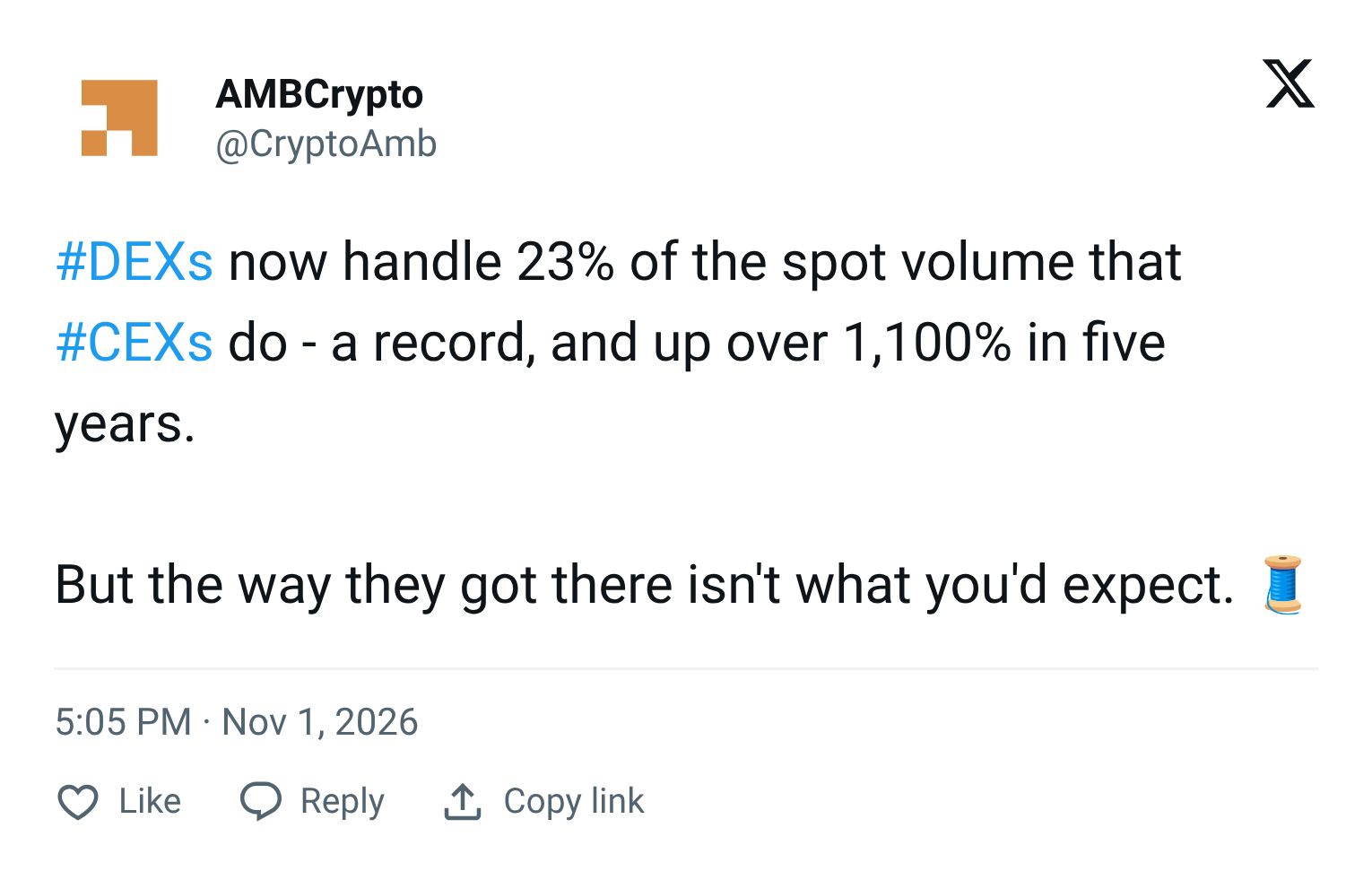
The interesting detail is that DEX volume fell too. The comparison puts that decline at 55%, yet decentralized venues still gained ground because centralized activity fell harder. Uniswap and PancakeSwap together accounted for 36% of monthly DEX volume 🦄
A rising market makes almost every trading business look good.. People deposit money because their bags are going up and another leveraged position suddenly seems reasonable. When that stops, the places where people continue trading become more revealing.
That’s why onchain markets have reasons to keep users around beyond whatever an exchange decides to list. A position can become collateral elsewhere. Liquidity can earn fees while its owner does something else. Traders can reach assets without waiting for a listing committee to discover them six months after everyone else 🧠
DeFi gets a turn in the green
DeFi tokens led the recent post-binance-dump recovery. Injective and Ethena were among the leaders, while Morpho also posted strong gains. November 5 price snapshots showed UNI up roughly 8% over 24 hours and AAVE around 6%.
There is room for much more activity, too. Token Terminal’s figures put stablecoin deposits in DeFi at around $24 billion, roughly 8% of the stablecoin market. Deposits have grown substantially, but most stablecoins remain outside these protocols 🤔
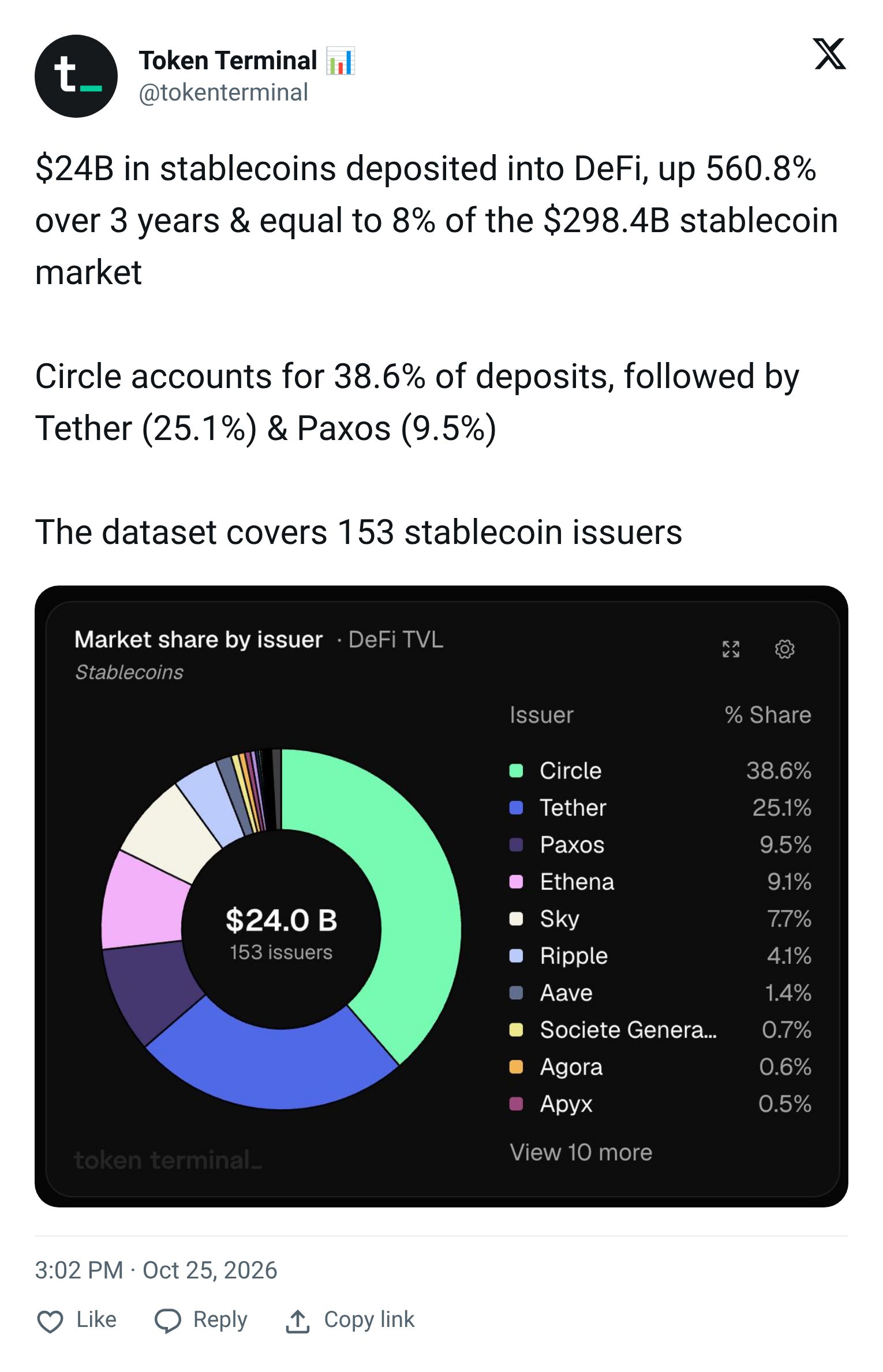
That money is not necessarily sitting around doing nothing. Stablecoins already move payments and settle trades elsewhere. Still, the gap gives DeFi something more substantial to compete for than another rotation between the same exhausted bags.
There’s also still the obvious factor - the advantage of being able to trade without handing a company permanent control of the account you trade from 🤷♂
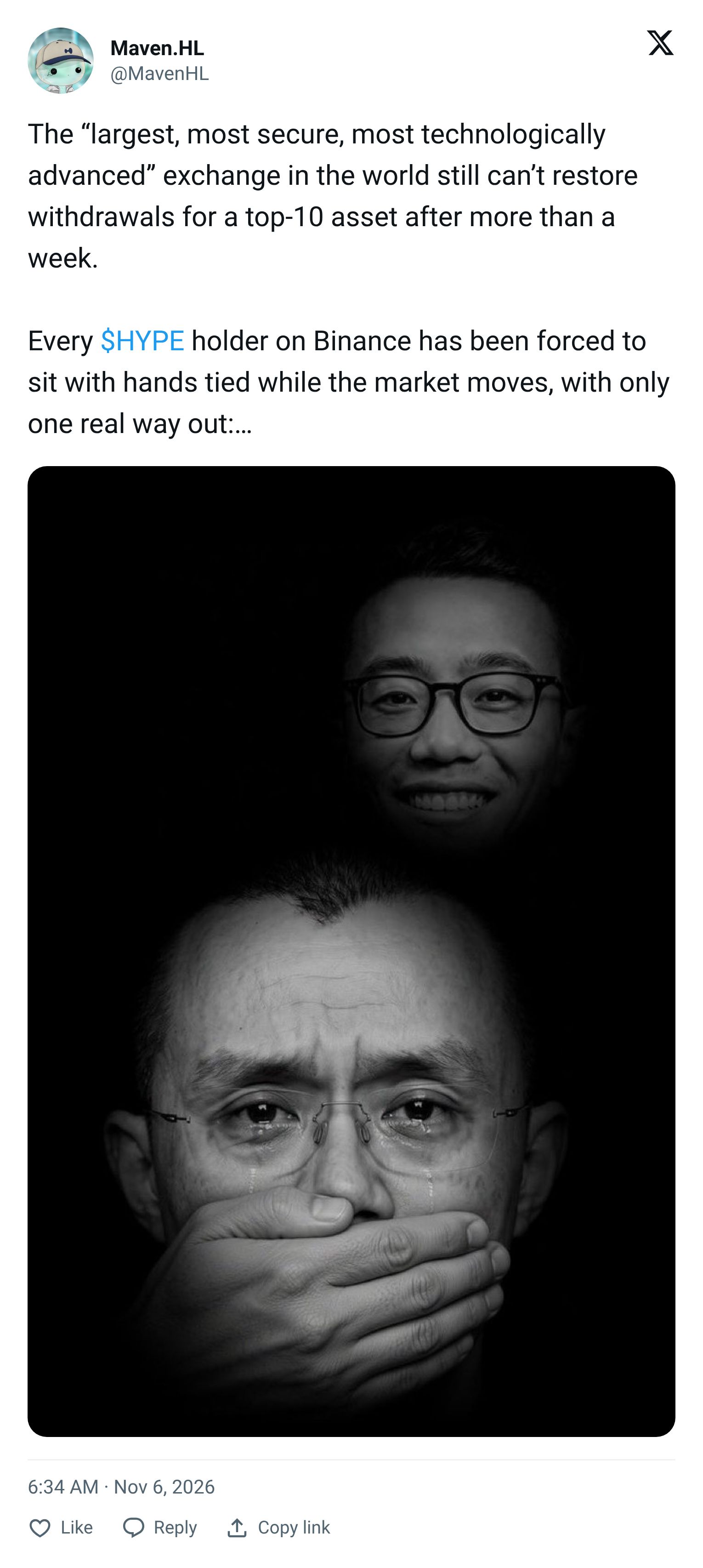
That looks a hell of a lot more like crypto’s true form than depositing everything with a business and hoping its security department earns its salary 🙃
And yeah an exchange can mistake a customer who cannot be bothered to leave for a customer who trusts it. Moving funds used to mean accepting enough extra hassle that plenty of people stayed put. But better onchain tools make that a much weaker business model.
Let exchanges compete for the next trade instead of assuming they get it because they already hold the balance. They might even have to spend more on making the service worth using and less on convincing everyone that the founder is a genius. Crypto could survive a few fewer celebrity CEOs 🤥
Crypto’s US plans meet a different Congress
Crypto businesses were already waiting for American politicians to finish deciding how their industry should operate. Now the midterms have changed who gets to make those decisions.
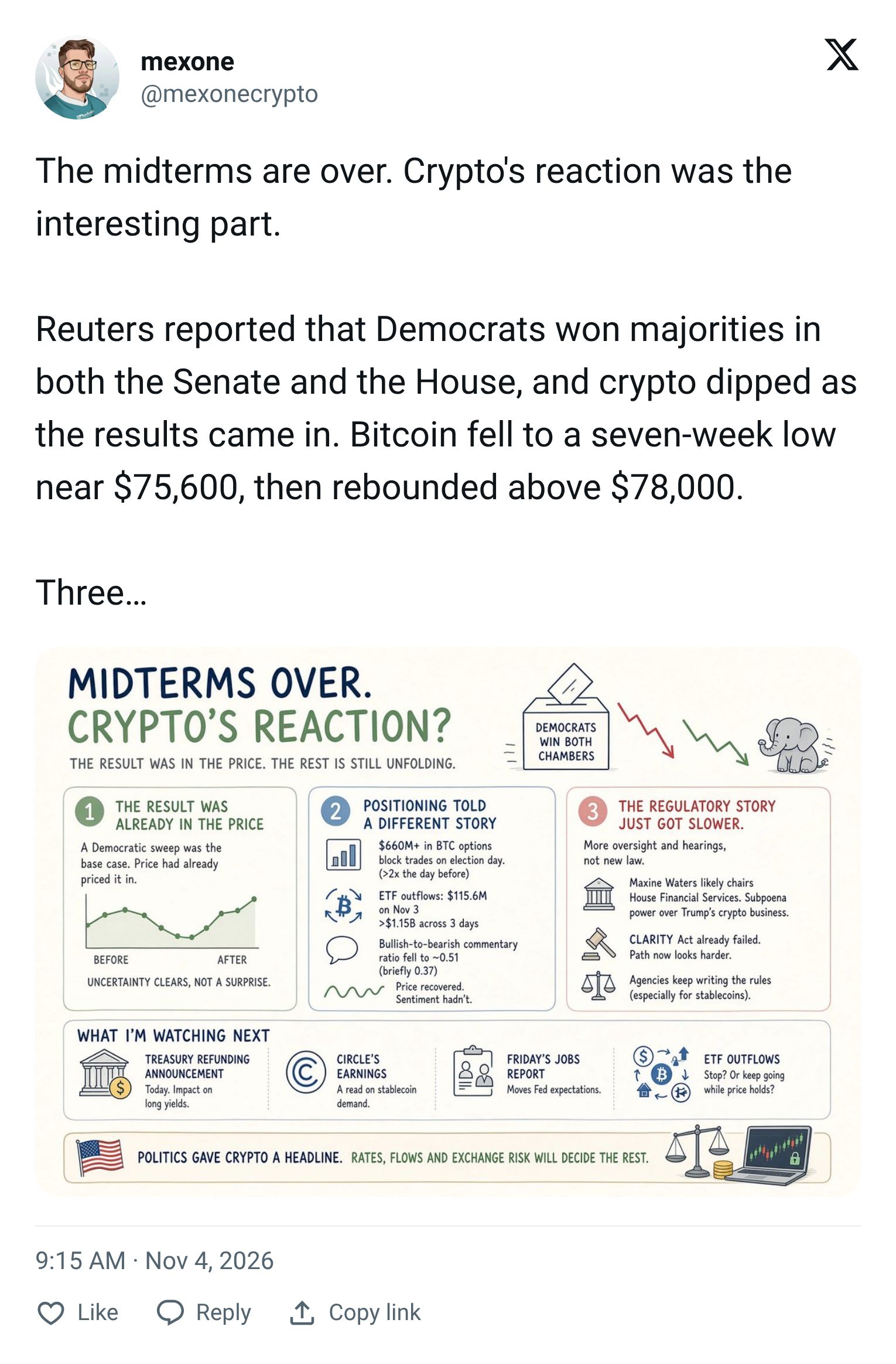
Democrats won both chambers of Congress, giving them control over the committees handling crypto legislation when the new session begins in January. Trump remains president, with his administration still overseeing the regulators 🔍
That leaves crypto dealing with a government whose two sides have very different ideas about what needs fixing. Safe to say, anyone expecting the remaining rules to sail through can put that fantasy back beside their altseason predictions 😔
The biggest immediate casualty could be the CLARITY Act.
The bill was supposed to settle the division of responsibilities between the SEC and CFTC and establish clearer conditions for crypto businesses. Its failure to pass already left companies planning around rules that might change. The election makes getting it finished considerably harder.
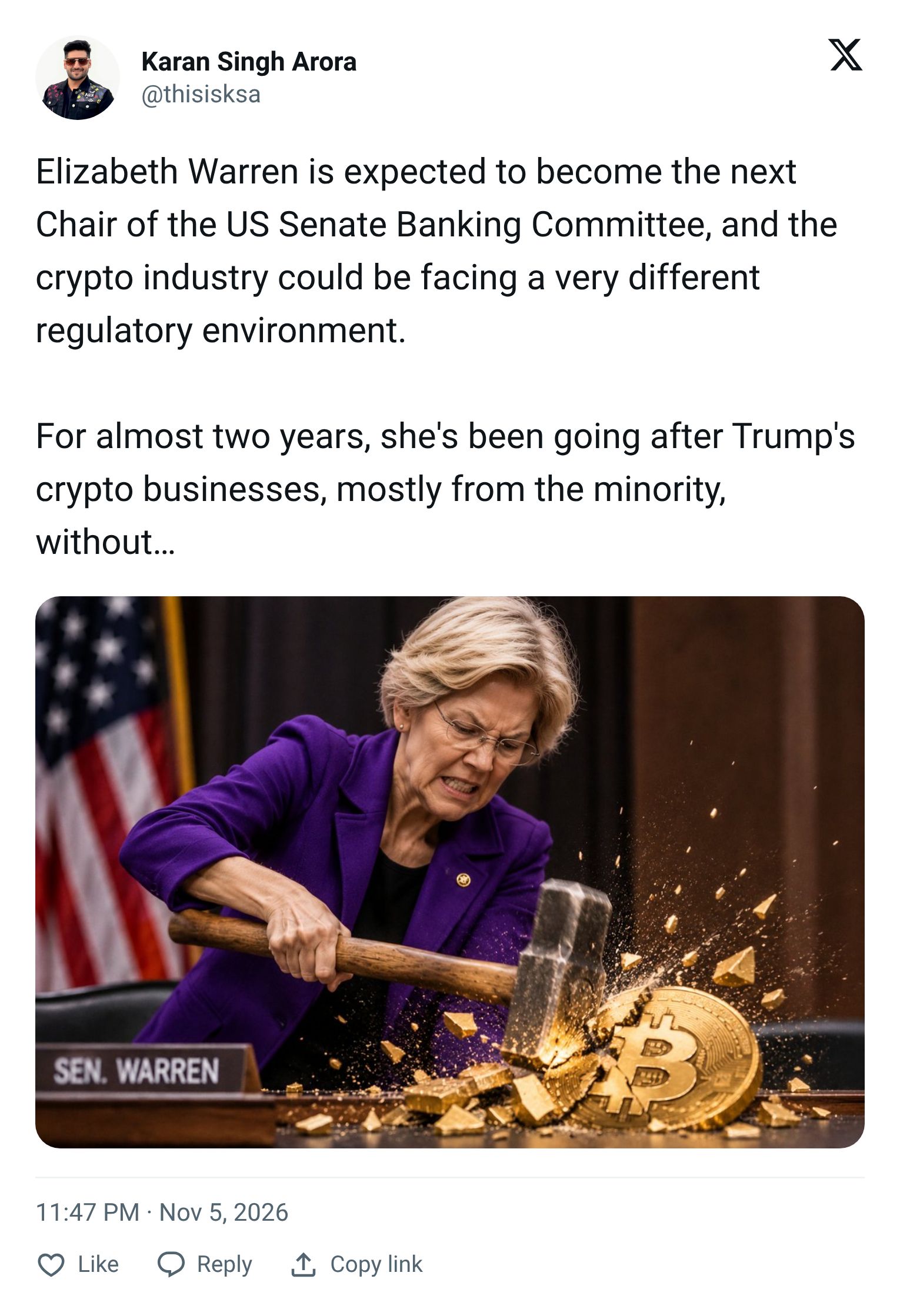
Massachusetts senator Elizabeth Warren is in line to lead the Senate Banking Committee. That gives a politician deeply suspicious of the industry much more influence over which proposals advance and what gets rewritten 🪶
TD Cowen analyst Jaret Seiberg expects legislation acceptable to the industry to be unlikely over the next two years. That’s still a forecast so things could change, nonetheless it’s a miserable one for companies waiting for an answer 🔒

For businesses outside the US, this still affects which American partners can serve them and what products reach a much larger market.
The likely result is more negotiation over investor protections and conflicts of interest. Companies may get stricter conditions than they expected, or another stretch of operating without the law they were promised. Neither outcome looks much like the easy business environment being advertised.
The election does not remove Trump’s SEC and CFTC leadership. Those agencies can continue making decisions within their existing authority. The GENIUS Act, which established a framework for stablecoins, is already law and does not vanish because congressional control changed. For now 🤔
But what changes is how much scrutiny the regulators face. Democratic committee leaders can demand explanations for decisions and investigate relationships between the administration and businesses benefiting from them. An agency may still make a decision, but defending it in public becomes a separate job 🤷♂
Trump supplied his opponents with particularly convenient material.
Democrats are preparing investigations into his family’s business dealings, and their earlier demands already covered TRUMP and World Liberty Financial 🍊
Warren and Connecticut senator Richard Blumenthal asked the SEC to investigate the memecoin in August. Warren and senator Chris Murphy separately questioned potential conflicts involving World Liberty and Middle East envoy Steve Witkoff.
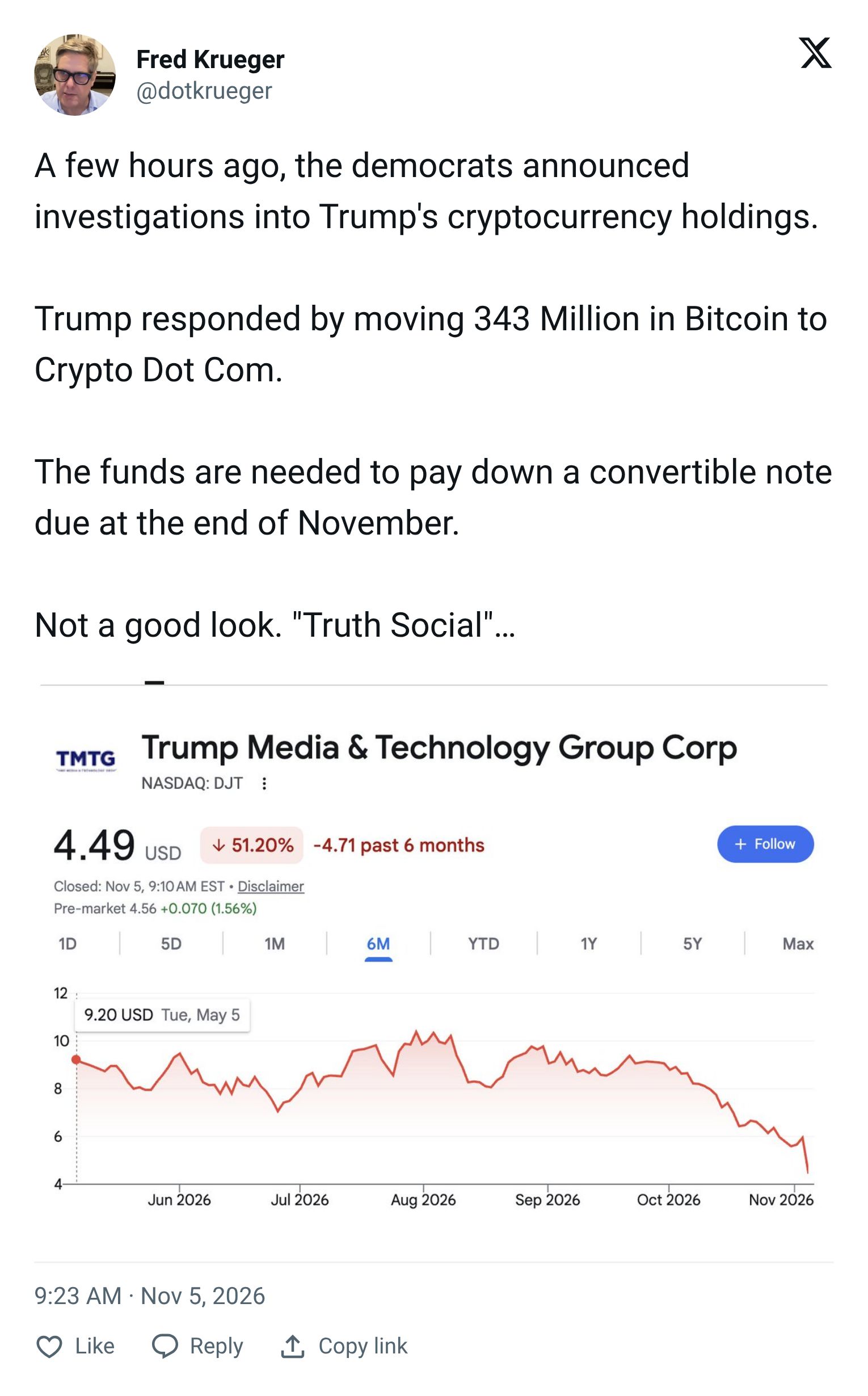
The danger for the industry is that arguments over workable market rules keep getting dragged back into the president’s personal interests. Trump managed to turn a potential legislative compromise into something his opponents can attack as protection for his family business. Excellent work from crypto’s savior 😐
There are also incoming Democrats who support crypto rights. One example is Maine’s Troy Jackson who has backed self custody and opposed cutting lawful crypto businesses off from banking. A change in party control therefore does not tell us how every individual proposal will fare.
For now, the market has avoided treating the result as an automatic disaster. Prices fell around the election, then recovered alongside US stocks. BTC rebounded more than 4% from its dip, while DeFi tokens helped lead the broader recovery. Trump linked tokens dumped, as expected.

CoinShares research head James Butterfill pointed to fading election uncertainty as a reason for relief. Knowing which government you have can be preferable to spending another night guessing 💰
More will be revealed when the committees start working. One thing is some hearing about a dubious token launch or president’s shady bags - it’s easy television, but producing rules that let an ordinary company operate without hiring lawyers to interpret every new statement requires considerably more effort 🧠
Democrats now have enough control to demonstrate whether protecting consumers includes letting them use things.
The “old phone” wallet shortcut leaves too much out
Back in July, investigator ZachXBT called hardware wallets “complete garbage” and recommended a separate iPhone used only for funds and transaction signing. His complaint included the frustration of updates interrupting important transactions 📱
This was quoted and used as an argument numerous times but even back then Trezor executive Danny Sanders pushed back against this idea:

A dedicated signing phone can be a deliberate security choice but that doesn’t make every abandoned iPhone suitable, and it certainly does not turn a seed saved in Notes into cold storage 👇
Your phone’s age is doing more work than airplane mode
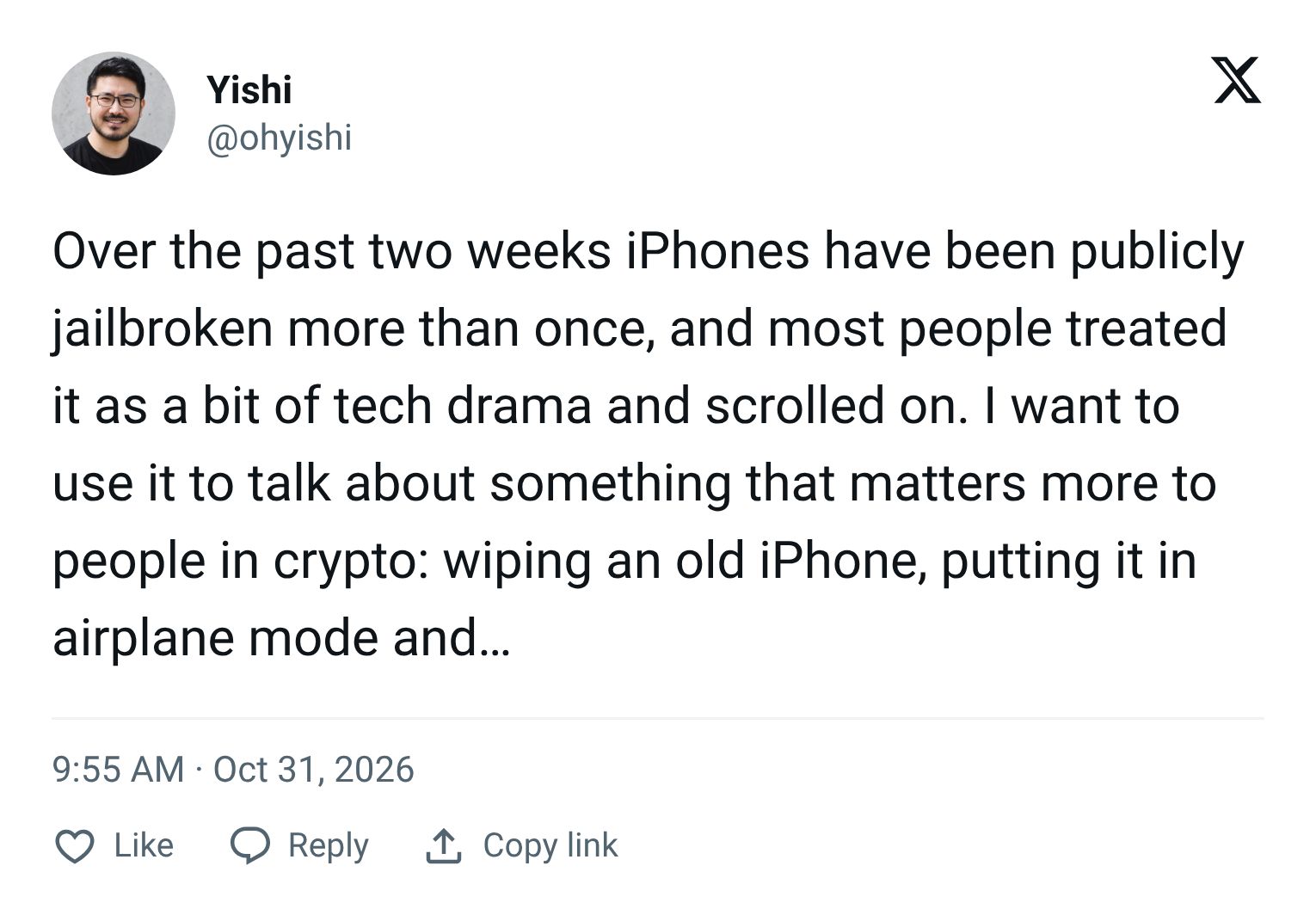
OneKey founder Yishi has reopened the argument following recent iPhone jailbreak demonstrations.
Researchers at Calif published demonstrations from Hexacon in Paris on October 16, including attacks involving Signal and iMessage. Yishi’s post describes a compromise that survived a reboot and points to further jailbreak claims that followed 🔨
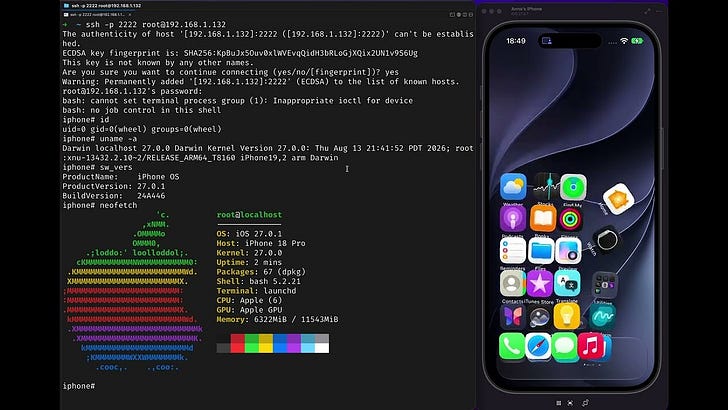
The older devices are his main concern. The public checkm8 exploit affects the iPhone 4S through iPhone X. The usbliter8 research extends low level attack concerns to models including the XS, XR and iPhone 11 family 🤳
These attacks involve code or hardware behavior that an ordinary iOS update cannot simply replace. With physical access and suitable equipment, an attacker can reach the device below the operating system. Keeping the phone offline does not stop somebody plugging into it 🪛
That is a fairly important omission from the popular “wipe an old iPhone and put it in airplane mode” instructions:
Getting low level control of a phone does not automatically reveal its passcode or decrypt every wallet. The way an app protects its secrets still matter. A successful attack against one layer is not proof that all the remaining layers have disappeared ⚙
But the remaining protection depends on how the device was set up.
If the seed is stored in a file protected only by a weak password, obtaining that file can let an attacker keep guessing away from the phone. A strong device passcode is useful, but it cannot repair every bad storage decision inside an app. An old operating system adds known vulnerabilities to the situation 📜

The phone being out of daily use can make this worse. People stop updating it precisely because they think taking it offline finished the security work.
A stolen device is an obvious problem. A device briefly accessed and returned can be harder to notice. Somebody does not need to keep your makeshift vault if they have already copied what they came for.
The sensible conclusion is narrower than “iPhones are unsafe” or “hardware wallets are garbage”
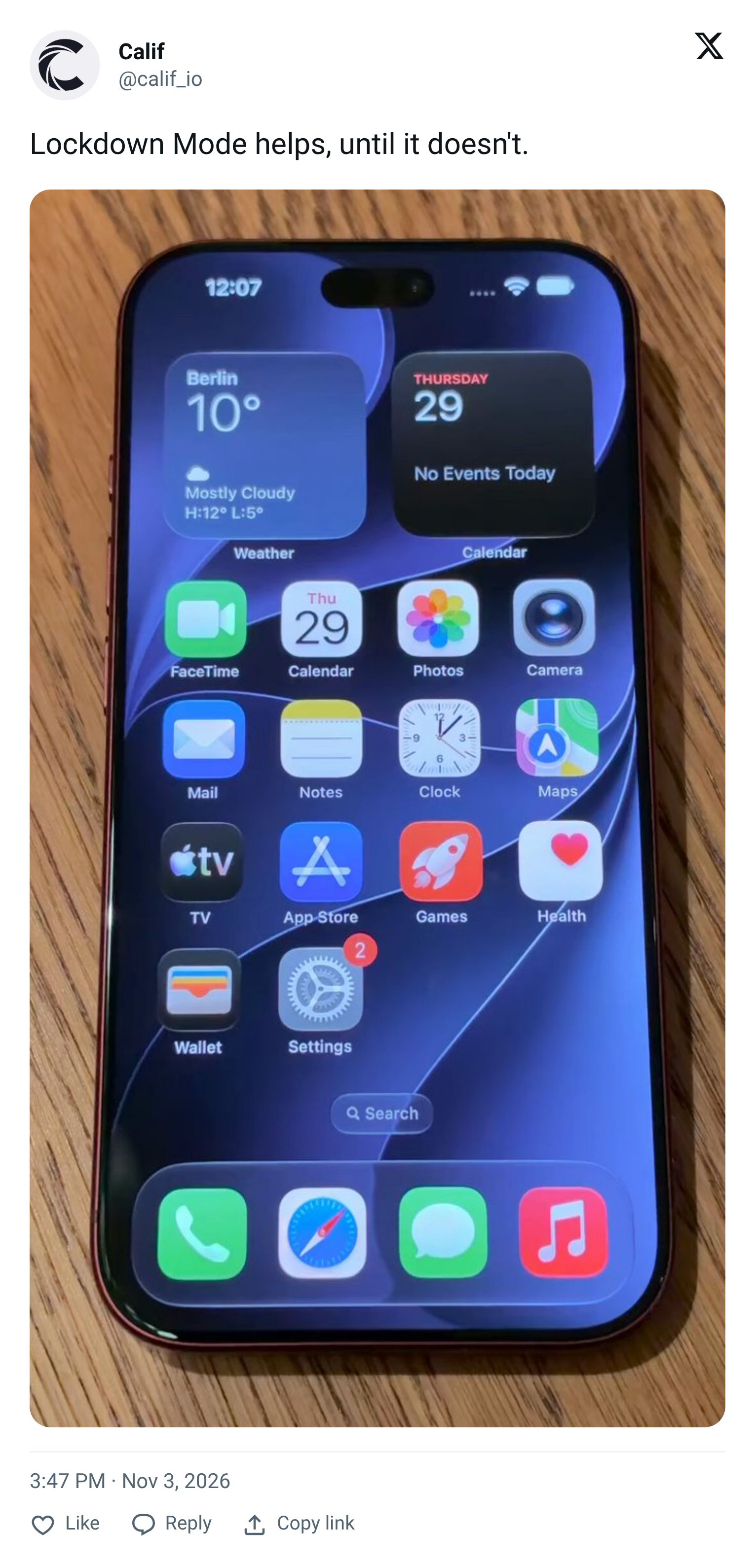
A recent, updated phone used only for signing has a different risk profile from an old model with permanent low level vulnerabilities. How the wallet handles keys matters. So does a strong alphanumeric passcode, and whether anyone else can get physical access.
Yishi says there is no public BootROM exploit for iPhone 12 or later. But no one can promise that a future hardware flaw would be fixable with software. Newer does not mean exempt from the laws of hardware 🛠
Anyone who suspects their seed has been exposed needs a newly generated seed in a trusted setup. Moving funds to another address derived from the same seed does not remove the problem.
There is plenty to criticize in dedicated hardware wallets, particularly when the signing experience is miserable or the device does a poor job showing what it is approving. Their failures deserve scrutiny without turning a drawer full of old electronics into the replacement security standard 🛡
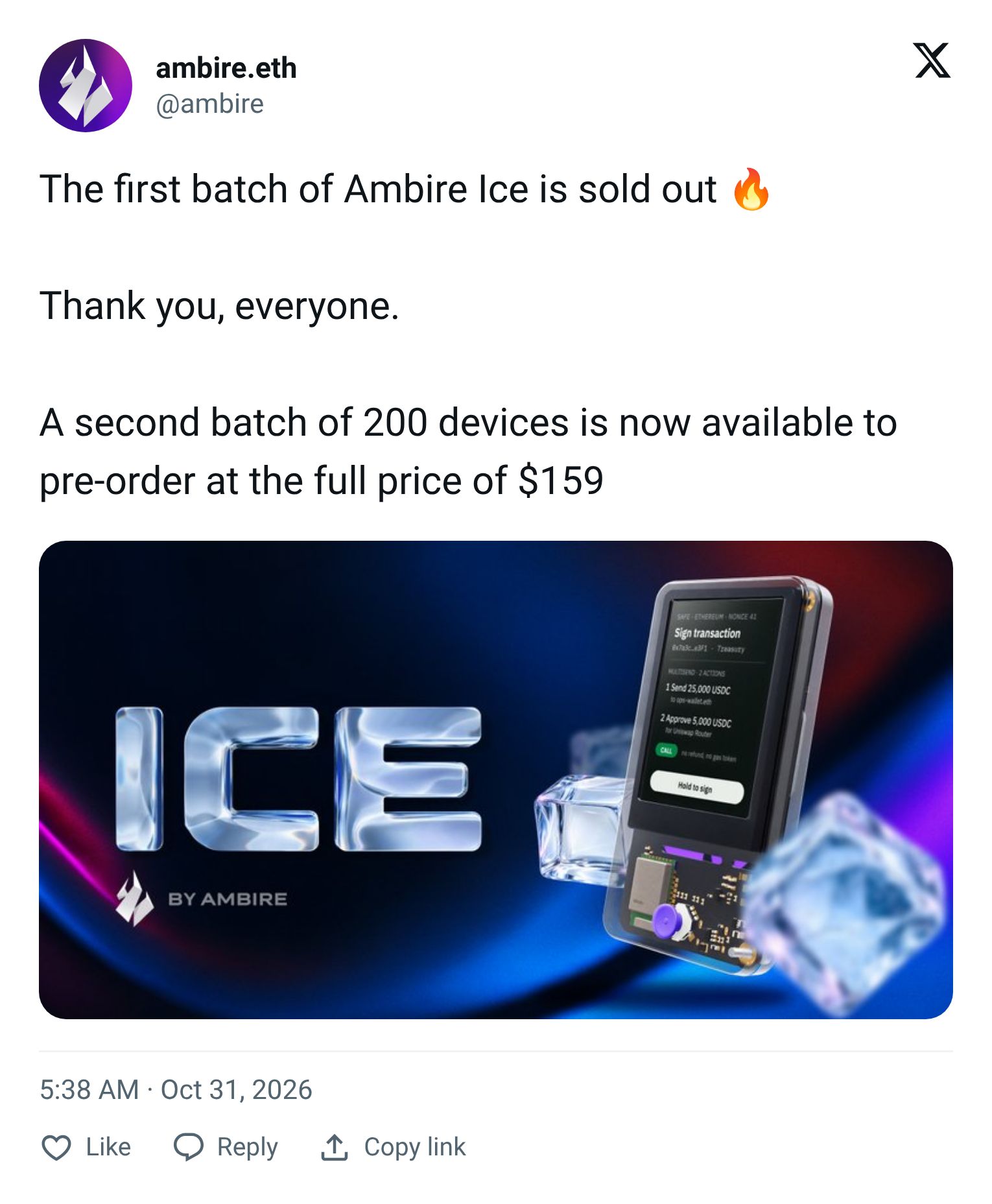
Btw, talking about hardware, the first batch of Ambire Ice preorders has sold out, and the team says the second batch is nearly ready 👀
But whatever device holds your keys, “I stopped using it for everything else” is a starting point for securing it. An attacker is under no obligation to respect the retirement.
Nico and Vitalik demo privacy inside Ambire
And on the topic of wallets, Nico and Vitalik Buterin showed another side of it at Devcon 8: keeping your activity private. Their demo used Ambire to show Kohaku, a toolkit that brings privacy and security features into existing wallets rather than asking everyone to move to another one.
The Ambire demos showed funds being shielded through Privacy Pools and a Tornado Cash deposit, with the option to batch deposits together. The familiar sending flow was deliberate. As Nico put it: “It looks like a regular send, and that was the goal.”
They also showed the slower experience over hotel WiFi and a VPN. Less flattering than a perfectly edited product video, but considerably closer to the conditions people actually use wallets in.
Vitalik said he wants the Ethereum Foundation using these tools for its own operations, with security and broader privacy protections developed alongside usability. The Ambire integration was demonstrated in beta, so this was a look at features in the works rather than a claim that everything is available to everyone already.
Keeping a payment to yourself should not require becoming the privacy expert in your group. Watch the demo highlights in Ambire’s tweet below 👇

Buying your way into a future Ethereum block
Blockspace is an underappreciated topic in crypto. Most people only think about it when a transaction costs too much or takes longer than expected. Then they swear at the network and get on with their day.
For a trading firm moving millions, that uncertainty can get expensive to shrug off. A delay can leave one side of a trade waiting while prices move against it. Paying ahead for a reliable place in a future block starts to look useful, especially if somebody can be held responsible when it goes wrong 💡
ETHGas wants to build a market around that demand. Its Blockspace Futures marketplace lets validators sell commitments to future Ethereum block capacity. Buyers can reserve a whole block’s available capacity and control how transactions are arranged within their allocation. They are buying a commitment to processing space, rather than buying ETH itself 📦
ETHGas is separately developing Institutional Blockspace for financial firms that want more control over the conditions in which their transactions happen.
Its documentation describes sanctions checks before inclusion and transaction ordering rules intended to reduce harmful MEV. Participating validators would be identifiable operators that an institution can assess and potentially hold accountable 🤓

The appeal for Wall Street is fairly straightforward. A bank may want to use Ethereum’s existing markets without explaining to its compliance department that an important transaction depends on an operator known only by an anime avatar 🥸
A blockspace market in this case would offer a route through public Ethereum with more familiar business conditions. According to founder Kevin Lepsoe, participation is optional and does not filter everyone else’s activity. Ethereum still determines who proposes each block.
Only about 5% of the network currently qualifies for the proposed institutional service. A Delphi model puts the average wait for an eligible validator at roughly four minutes at that coverage. With 30% coverage, it falls to around 40 seconds.
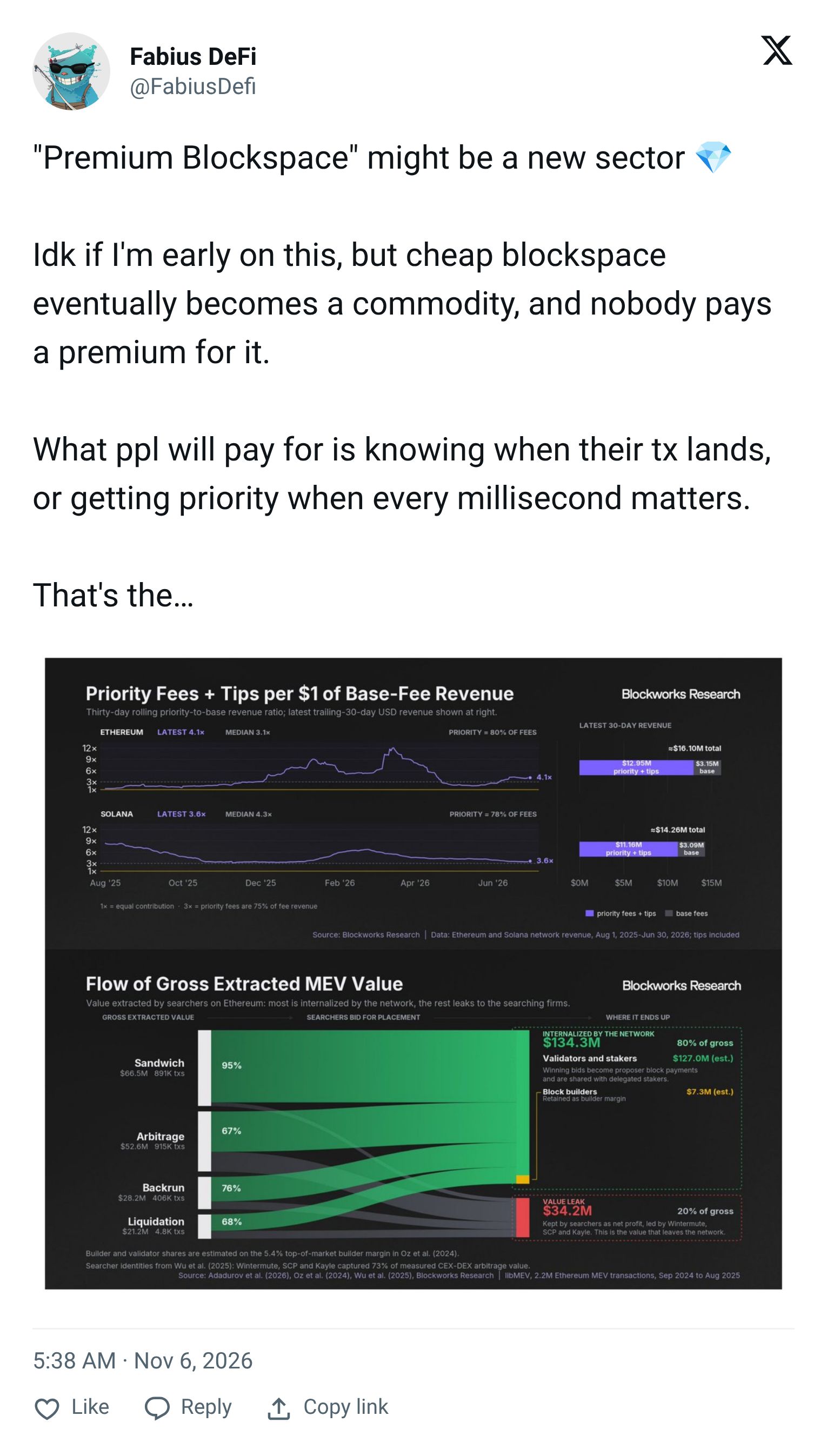
The distinction is especially important for trading. An inclusion commitment promises space for a transaction; it does not make every intended trade succeed regardless of changing conditions 💹
The most revealing commercial detail is what happens when that commitment is missed.
ETHGas says collateral and a compensation mechanism exist. The current compensation amount is zero. A customer receives no financial payout under those terms. Neither Lepsoe nor the company funded Delphi report identified a bank using Institutional Blockspace in production.
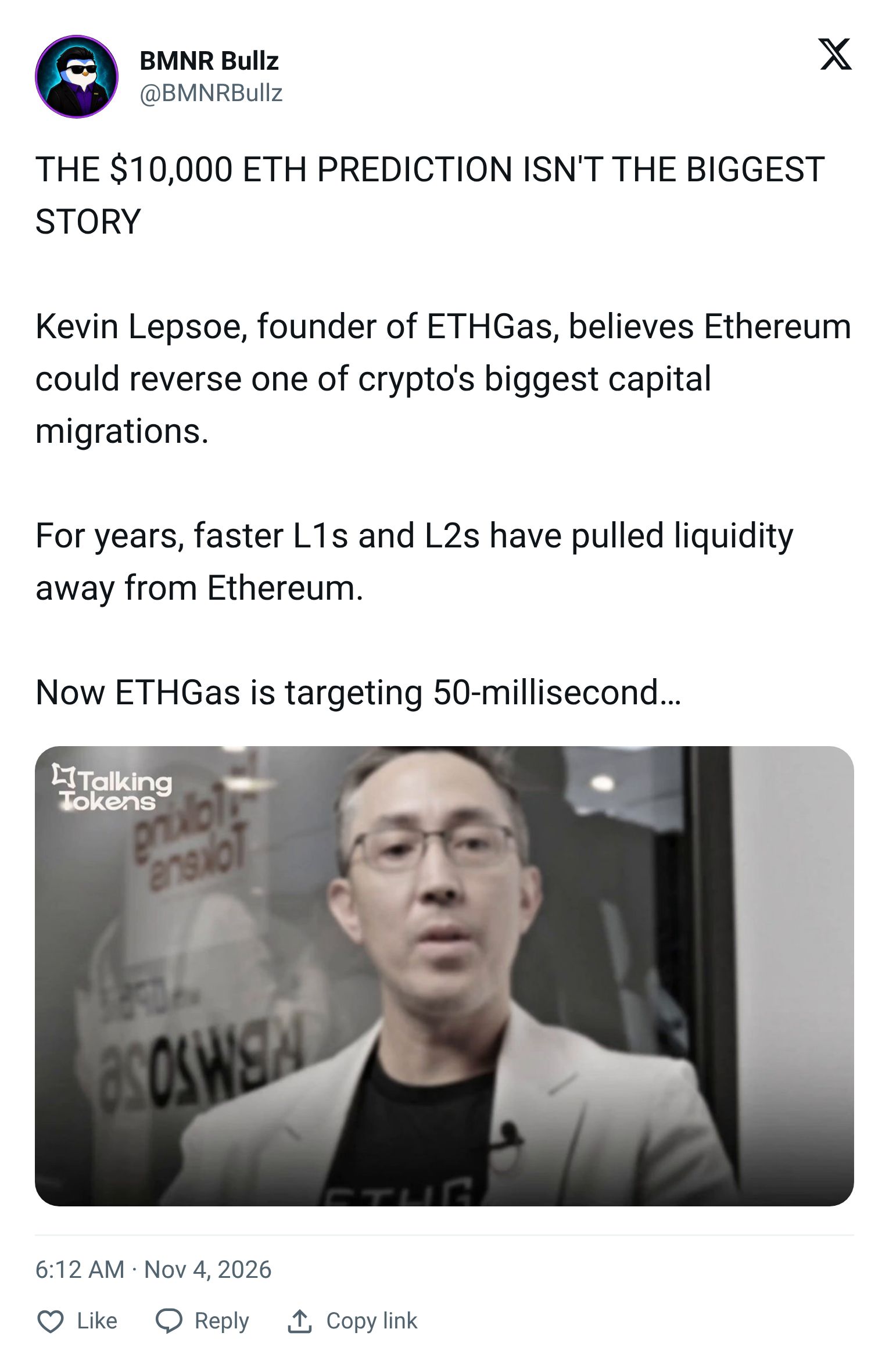
Once access to future blocks has a price, traders could potentially have a reason to buy it without ever intending to use it. They could reserve capacity expecting to sell it for more when the network gets busy and banks trying to make settlement more predictable might find themselves competing with people betting on their urgency 🤏
It is easy to imagine a market growing around that, with its own borrowed funds and spectacularly bad positions. Wall Street would probably feel right at home. Also, who knows, but crypto might finally even offer the experience of getting liquidated before you submit the transaction 🫡
Other worthy reads
“One Last Hurdle Before Year-End” - Duality Research:

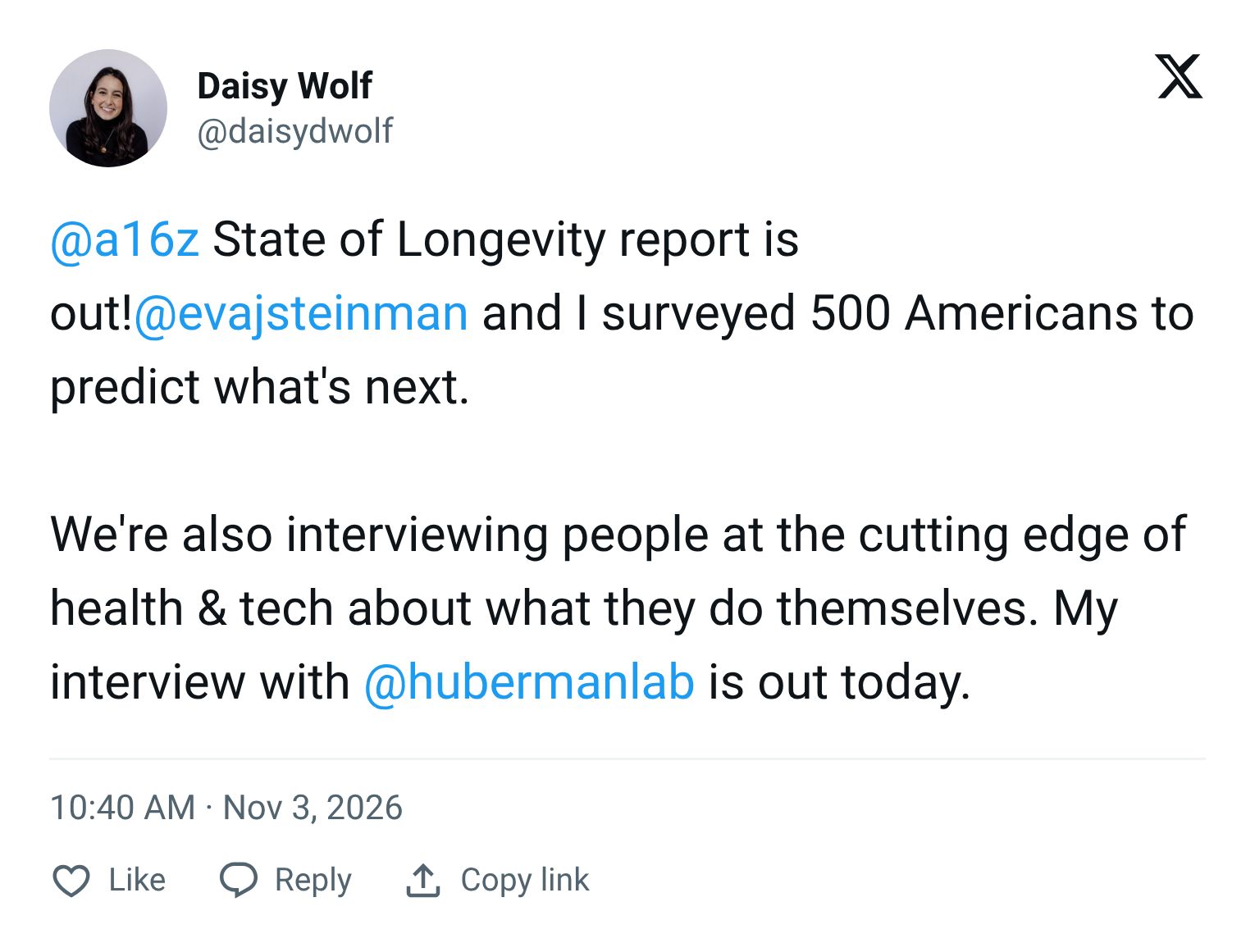
“The State of Longevity” - Daisy Wolf:
“The McDonaldization of Venture Capital” - Kyle Harrison:

MEMES


That’s it for this week, frens.
If you enjoyed this edition, share the newsletter with someone who would enjoy it too. It only takes a few seconds and helps more people discover W3OF without us having to beg an algorithm for attention 💜
That’s us for this week. Keep an eye on the things that still matter after the excitement passes and we’ll see you next Friday.
Yours, The 🔥 Team
