

GM, frens! ☕️
Here’s this week’s TL;DR:
📨 When the biggest win in crypto was somebody getting their paycheck
After Ueno Bank of Paraguay collapse cut off banking to the majority of the population stablecoins gave people another way to get dollars and keep paying bills [here]
🥷 The strange road from an Ethereum staff letter to federal court
Former Ethereum Foundation staffer Kayleen Fulton sued over her firing, and her complaint puts a bizarre parody license front and center in an employment dispute [here]
🪓 The US Treasury is cutting MEXC off
FinCEN is cutting MEXC off from US financial institutions over an estimated $16.7 billion in likely illicit activity, while Binance is closing affected accounts in parts of the EU [here]
🐸 North Korean hack groups going full memecoin dev
North Korean operatives made stolen funds look like memecoin profits by trading their own homemade tokens, including one pitching Elon Musk for president. Investigators followed the funds anyway [here]
Plus:

And if you like our newsletter, we’d love for you to share it with someone who’d enjoy it too:

When the biggest win in crypto was somebody getting their paycheck
Imagine telling the people who work for you that you’ve got their pay ready, you just can’t send it - sounds like an excuse even when it’s true. And now those people have to go home and tell their families the same thing.
A situation like that is currently happening in Paraguay. Its central bank stepped in at Ueno Bank after finding that its solvency ratio was below half the required minimum. The situation caused a lot of problems (among them the ousting of the current president), but financially - nearly three million customers (roughly 60% of the population) were left without access to their accounts 🤯
The fact that it happened at the beginning of the month was particularly crappy: businesses were supposed to pay staff and suppliers, and households were expecting those wages to cover rent 💸
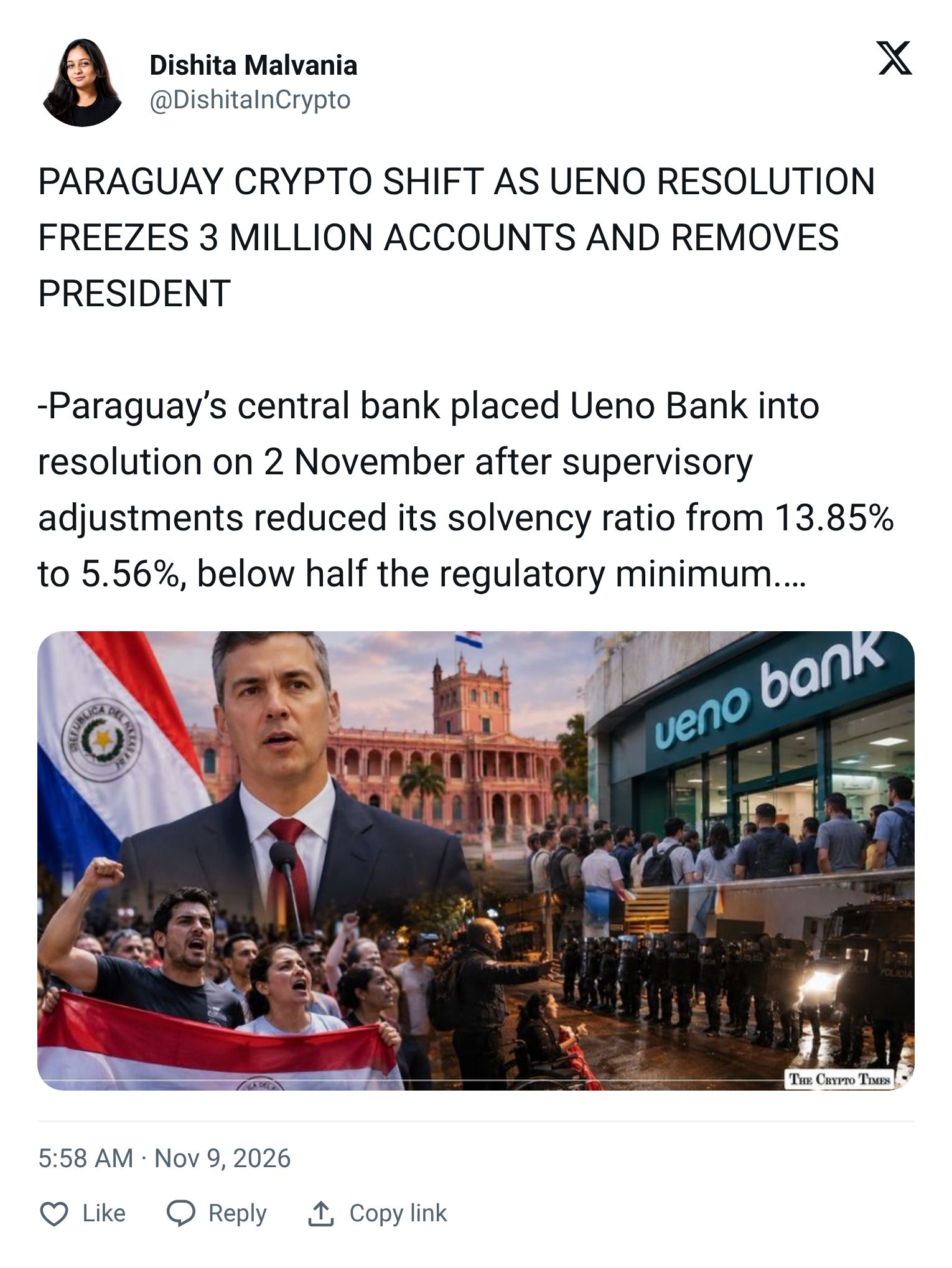
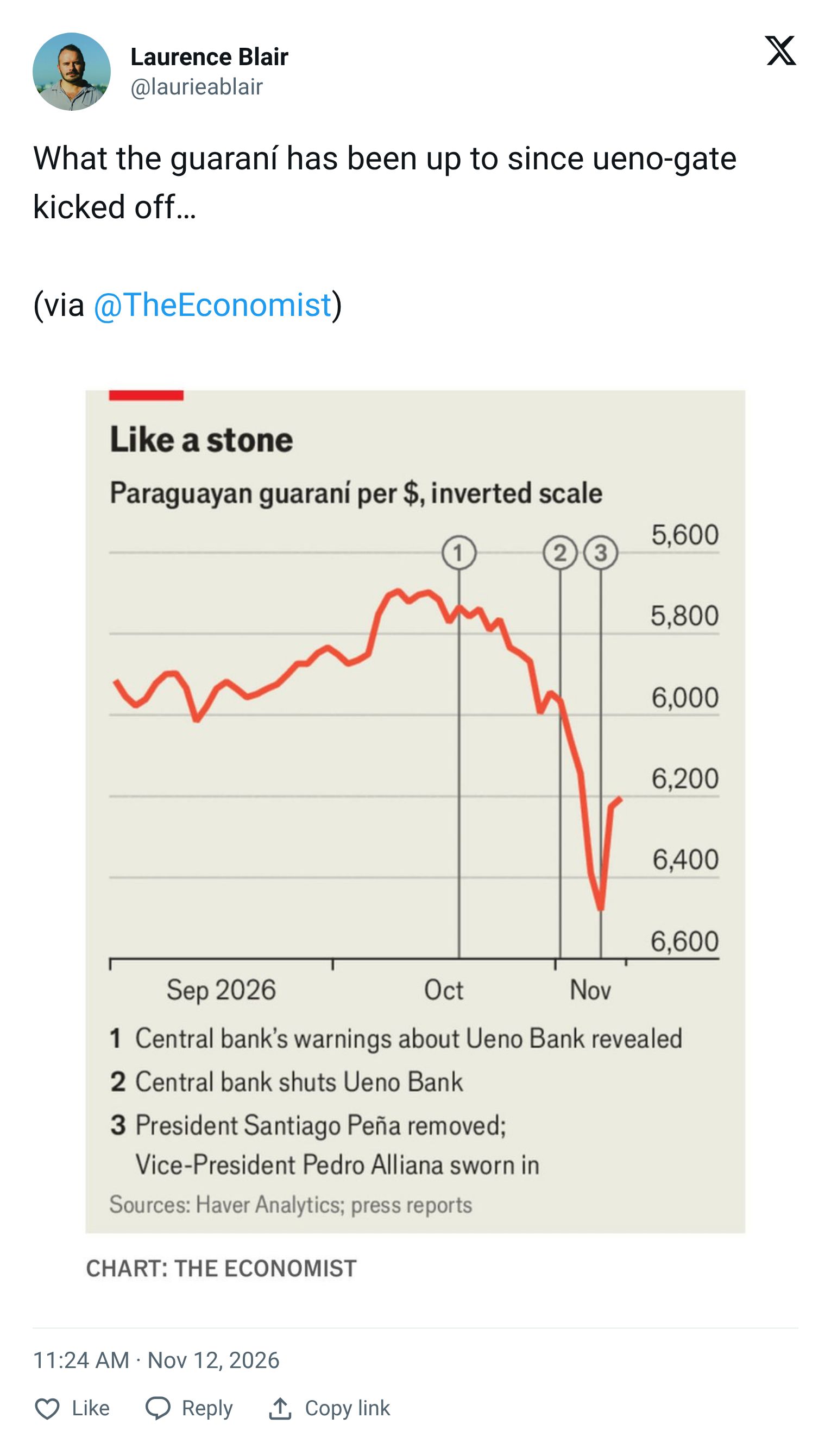
The guaraní (local currency) dropped 12.3% in a week. On p2p crypto markets, some sellers were asking up to 13% above the dollar for USDT.
That was the high end of the asking prices, but it gives you a sense of what was happening - people were suddenly willing to pay a lot for a dollar they could get hold of without waiting for a bank to sort itself out 🤕
The interesting bit is what people did once they had that option. Some customers were buying USDT and USDC to hold dollars while the guaraní was falling, others were doing the reverse, because they already had crypto and sold it for local currency or dollars to make payments they’d normally make through Ueno 💰

In that case, from the business owner’s side, it meant there was still a way to pay an invoice. If stablecoins were never a thing it wouldn’t be that easy 🤓
That’s a damn good argument for having a way to move value outside your usual bank. People who had assets they could move separately had an option when they actually needed one, which is a better advertisement for crypto than any number of people posting screenshots of what they made on a trade if you think about it
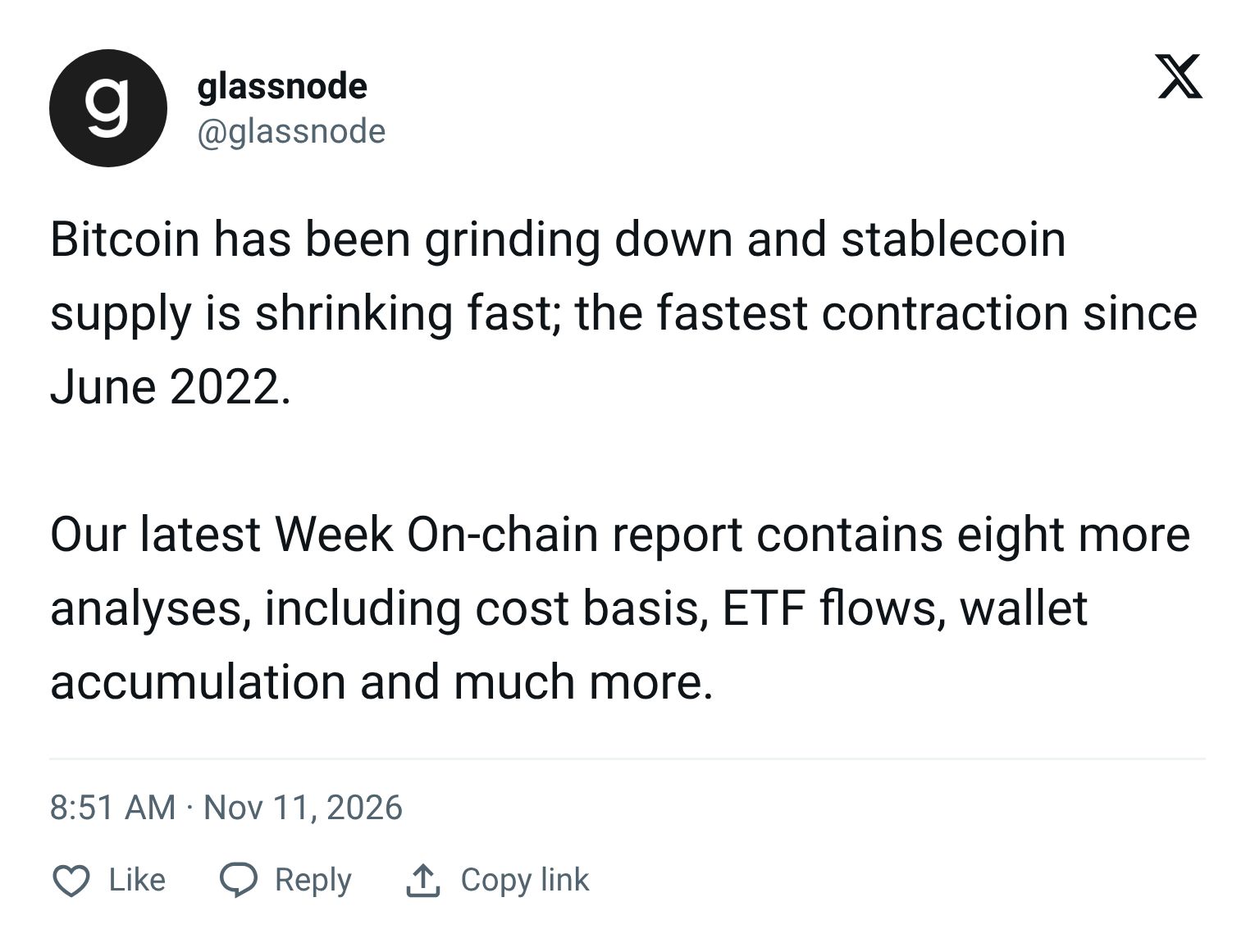
Meanwhile, Glassnode found that the supply of major stablecoins dropped by $14.2 billion over 30 days, the biggest contraction since the 2022 bear market. USDT and USDC accounted for nearly $11 billion of that decline. Traders care because fewer stablecoins in circulation can mean less cash sitting around ready to buy the next dip.
In Paraguay, people were being quoted a premium for the same dollars the rest of the market was pulling out. So one person was done waiting for a pump and another somewhere was done waiting for a bank 🤔
The good thing about this use case is that the person on the other end might never find out crypto was involved. The invoice just says paid.
The strange road from an Ethereum staff letter to federal court
One thing we appreciate about the Ethereum Foundation is that it takes the freedom to use Ethereum seriously.
You should be able to use the network without someone else’s permission and have some privacy when you do.
In March, the board put those principles in writing. It called the document the EF Mandate and wrote it mainly for its own teams, so they’d have something to refer back to when deciding what to work on and what they weren’t willing to give up along the way 🔒
The document also had a bit of old internet humor in it. There was a parody software license called the Source Seppuku License, complete with a clause about falling on your sword if you broke its terms. The published version put it next to a winking anime character and some cartoon cats. And of all the things in the mandate, that’s the passage a former employee chose to put on the first page... of her lawsuit 🫣
According to Kayleen Fulton, better known as Nixo, staff were told in March that they had to personally commit to the mandate or get fired. Fulton led the Foundation’s protocol support team.
She and colleague Trent Van Epps helped put together a letter saying they supported the goals but objected to making endorsement a condition of keeping their jobs. Fifty three people signed.
Fulton says she told management she had cancer on March 24. She alleges that Bastian Aue, then a co executive director, fired her on April 6 and fired Van Epps the same day, about half an hour apart.
On November 4 she sued in federal court in Colorado, alleging disability discrimination, retaliation and interference with her medical leave rights 🤯
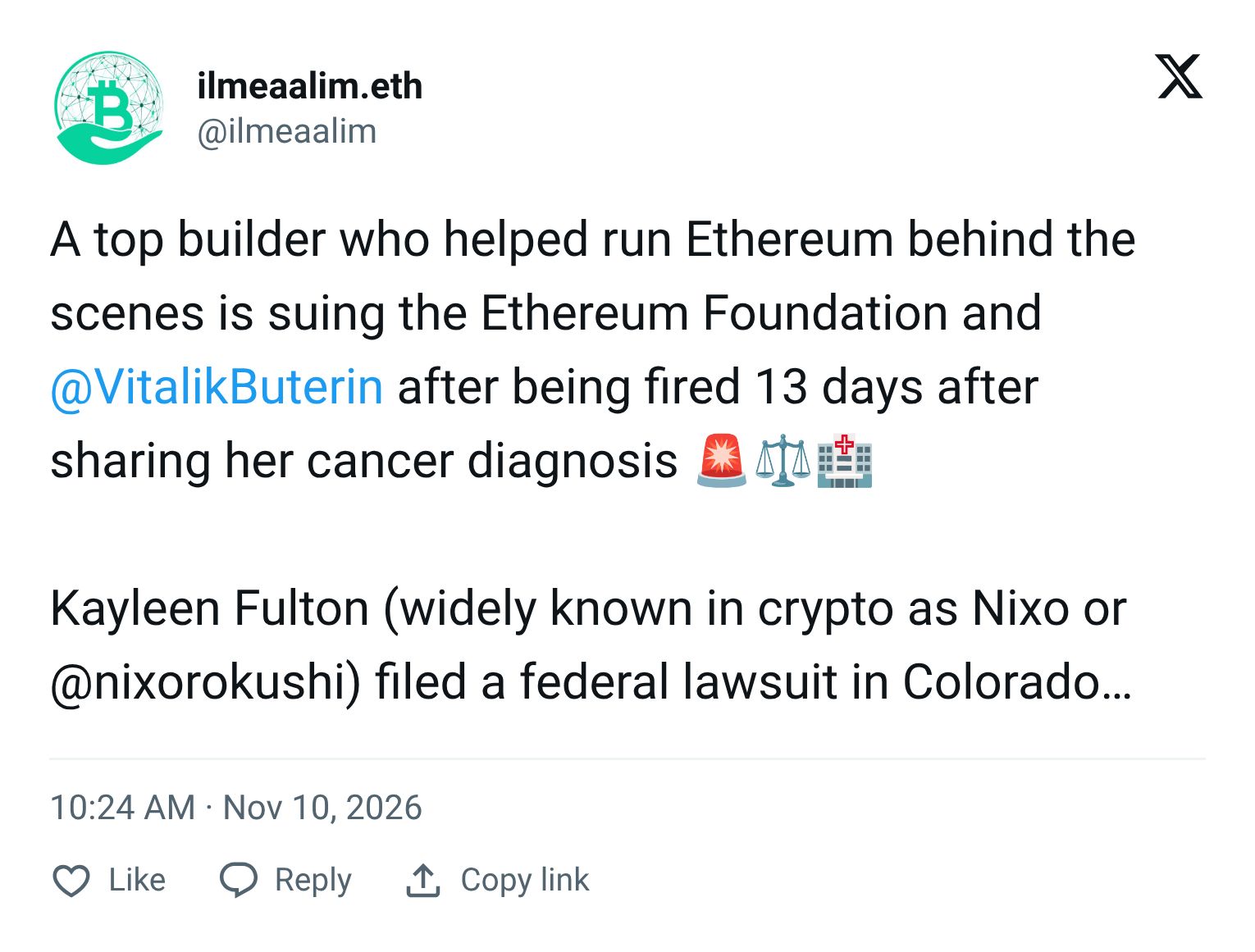
Vitalik Buterin is one of six defendants. The complaint says he helped adopt and enforce the directive as a board member, while Aue is the one Fulton says actually fired her. A lawyer for the Foundation’s Singapore affiliate denied unlawful conduct and retaliation and said Fulton’s separation agreement was binding.
There’s a fairly straightforward case to tell from Fulton’s side. She says she told her employer about a diagnosis, raised an objection alongside dozens of coworkers and was out of a job less than two weeks later 🤷♂
Those dates give a court something specific to work through. Instead, the first page makes sure you know about the sword.
The complaint calls it a “suicide pledge” but the same account includes Aue explaining that the wording was figurative. There’s plenty of room for a discussion on whether the management should or shouldn’t put a joke in there but trying to get the reader to picture the Foundation actually issuing swords takes it somewhere considerably dumber 🤡
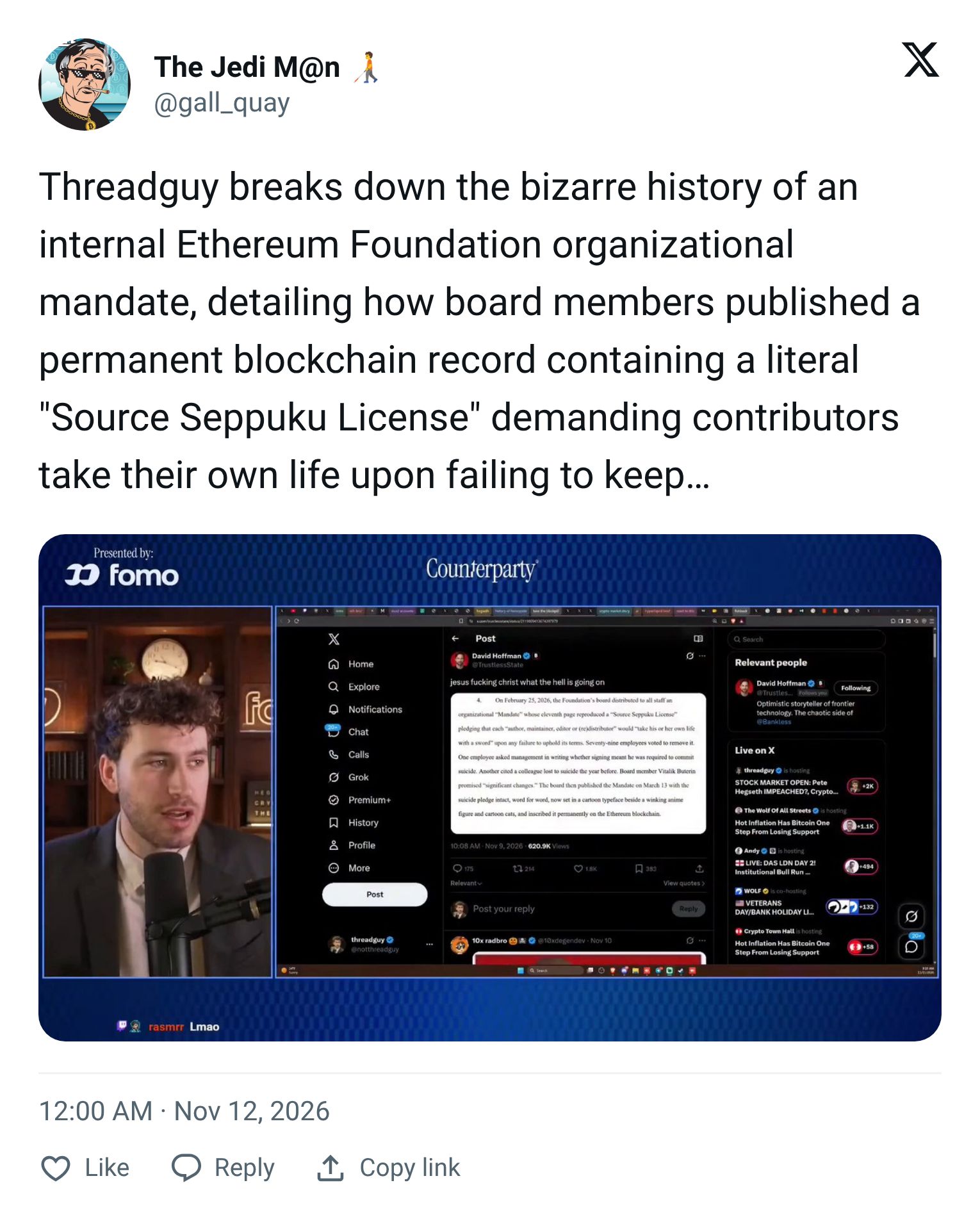
What makes it such a strange choice is that the employment dispute makes sense without the theatrics. The staff letter reportedly agreed with what the Foundation wanted to achieve. The disagreement was over being told to personally affirm the document to stay employed. Treating the most ridiculous paragraph as though it were the clearest statement of what staff were expected to do makes that objection sound less serious than it actually was 🤦♂

The trouble with outrage is that once it starts, everyone has a reason to make the thing sound a little worse. A quirky joke can just be a quirky joke if you’re talking to someone in person. Written down and sent to the lawyers - who quote it literally - and now you’re apparently taking a position on whether your coworkers should die at work.
Crypto has always had people who take the work seriously without taking themselves all that seriously. Ethereum in particular would be a much duller place if every little thing had to make sense to a stranger seeing it for the first time. But would you rather have the occasional joke that makes you cringe or spend the next ten years reading documents written by people who’ve learned that sounding like a person is a liability? 😶
The US treasury is cutting MEXC off
When an exchange asks you for one more photo of your passport, you’d like to think somebody takes the whole thing seriously. Otherwise you’re just sending strangers better pictures of your face for the privilege of paying them a fee.
Then you get a look at who the exchanges actually let through and you start to wonder how much of that effort was for your benefit 🤨
On November 6, the US Treasury’s Financial Crimes Enforcement Network issued an order to cut MEXC off from the US financial system. Starting December 10, covered US financial institutions can’t process transfers involving the exchange. MEXC can keep operating elsewhere, but any part of its business that depends on those institutions now has a problem.
FinCEN estimates that MEXC facilitated at least $16.7 billion in likely illicit activity between May 2021 and May 2026.
The agency linked transactions to sanctions evasion involving Russia, Iran and North Korea. It also identified nearly $2 billion in funds going to or coming from illicit cyber actors. This is the agency’s estimate of what passed through, rather than how much the exchange earned or how much it’s being fined.
For one case in particular, FinCEN says MEXC helped a sanctioned North Korean money launderer receive about $350,000 in 2025. The US had sanctioned him two years earlier and publicly identified his Crypto addresses at the time.
MEXC CEO Vugar Usi said the exchange was in touch with FinCEN and that trading, deposits and withdrawals were still working (well, they clearly understand what the regular users would start thinking of right away) 🙄
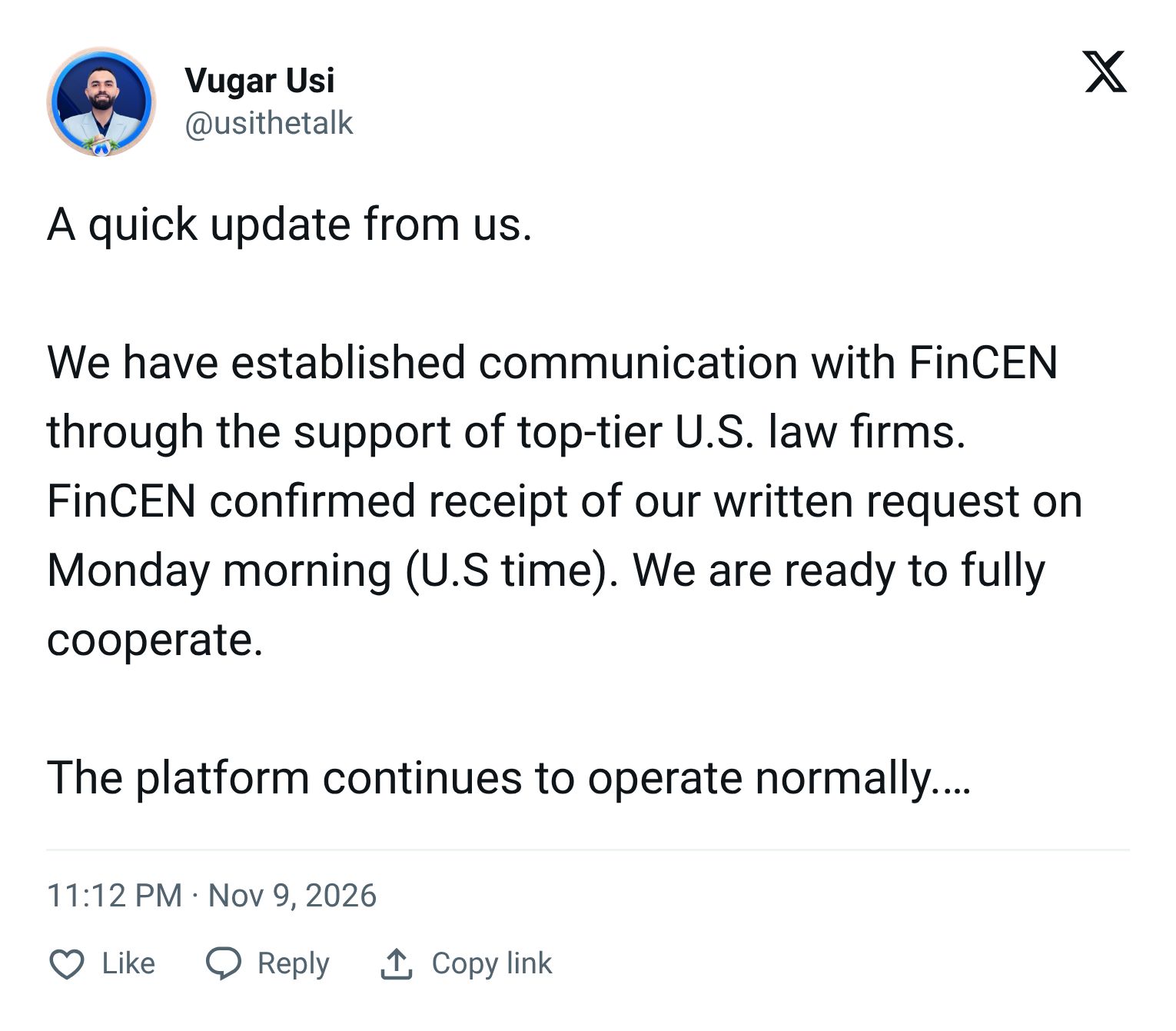
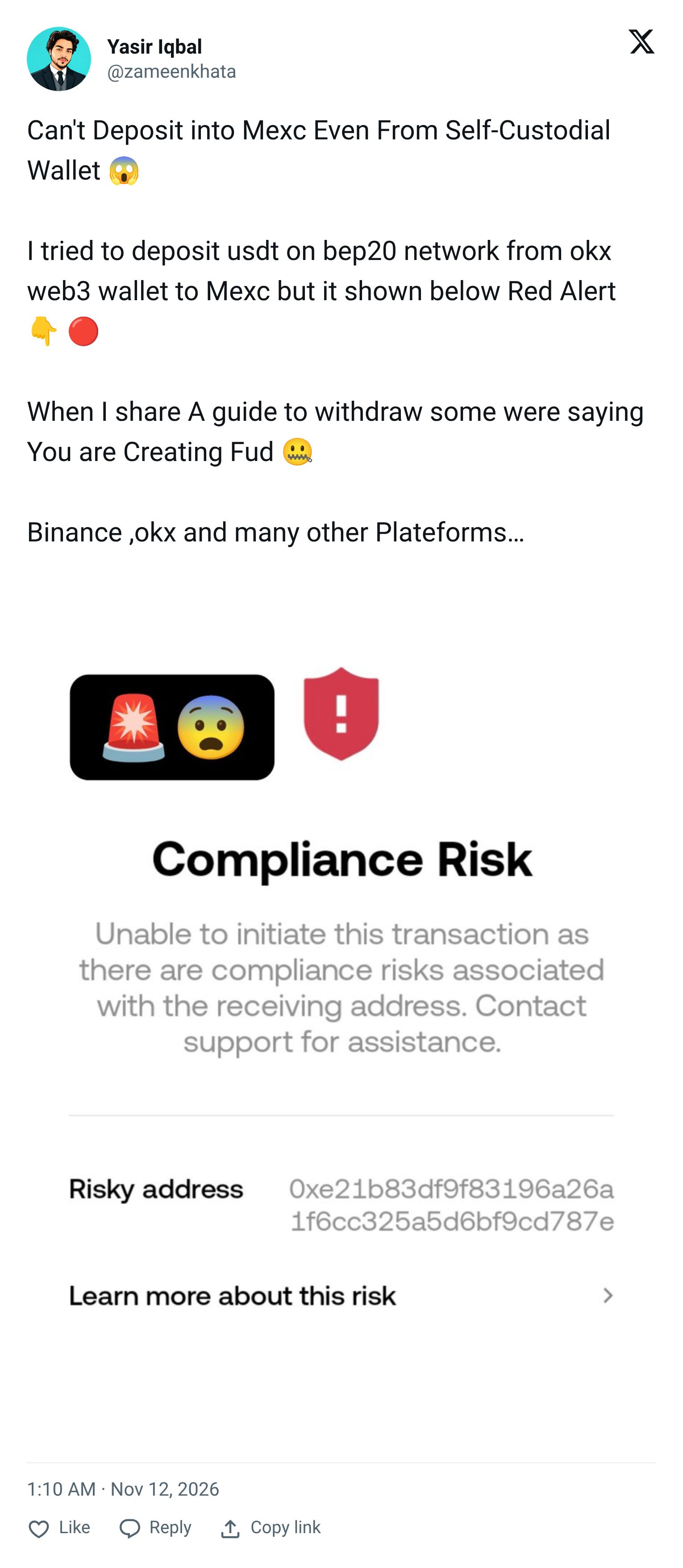
Binance told users to stop sending funds from MEXC and its affiliates and said related transfers would be reviewed and temporarily restricted. That’s where this starts reaching people who never opened an MEXC account. Another exchange can decide that where a transfer came from matters more than who’s trying to deposit it ✉
The license won’t do the work for you
Binance playing the responsible neighbor here is funny as hell. In 2023 it pleaded guilty and agreed to about $4.3 billion in penalties and forfeiture. The US Justice Department said it had put growth ahead of compliance and knowingly failed to put controls in place to prevent prohibited trades 🥴
By now Binance has a pretty good idea of what can happen when an exchange treats the business it would lose by following the rules as more important than the rules themselves. 🧙
Pick any CEX and the same logic applies. Coinbase held a New York license and still agreed to pay $50 million after the state found problems with its compliance program. BitMEX got a $100 million fine after pleading guilty to violating the Bank Secrecy Act. Those are different cases but what they have in common is that none of the checks that mattered happened because a customer saw the word “regulated” on a website and felt better 🥱
Being regulated originally meant somebody had the authority to inspect the business and make it answer for what it did. The exchange would much rather sell you the feeling that somebody has already inspected everything you could possibly worry about. Those are very different things, especially when the same people who run the exchange also decide how much business they’re willing to turn away.
In the meantime, Binance itself also lacks the MiCA license it needs to serve EU customers to this day, so it can’t legally operate anymore 🤐
People in Spain, France and Poland reported receiving notices telling them to withdraw. The exchange says affected accounts close December 31, with monthly fees on leftover balances starting November 29. The licensing issue is separate from the MEXC order.
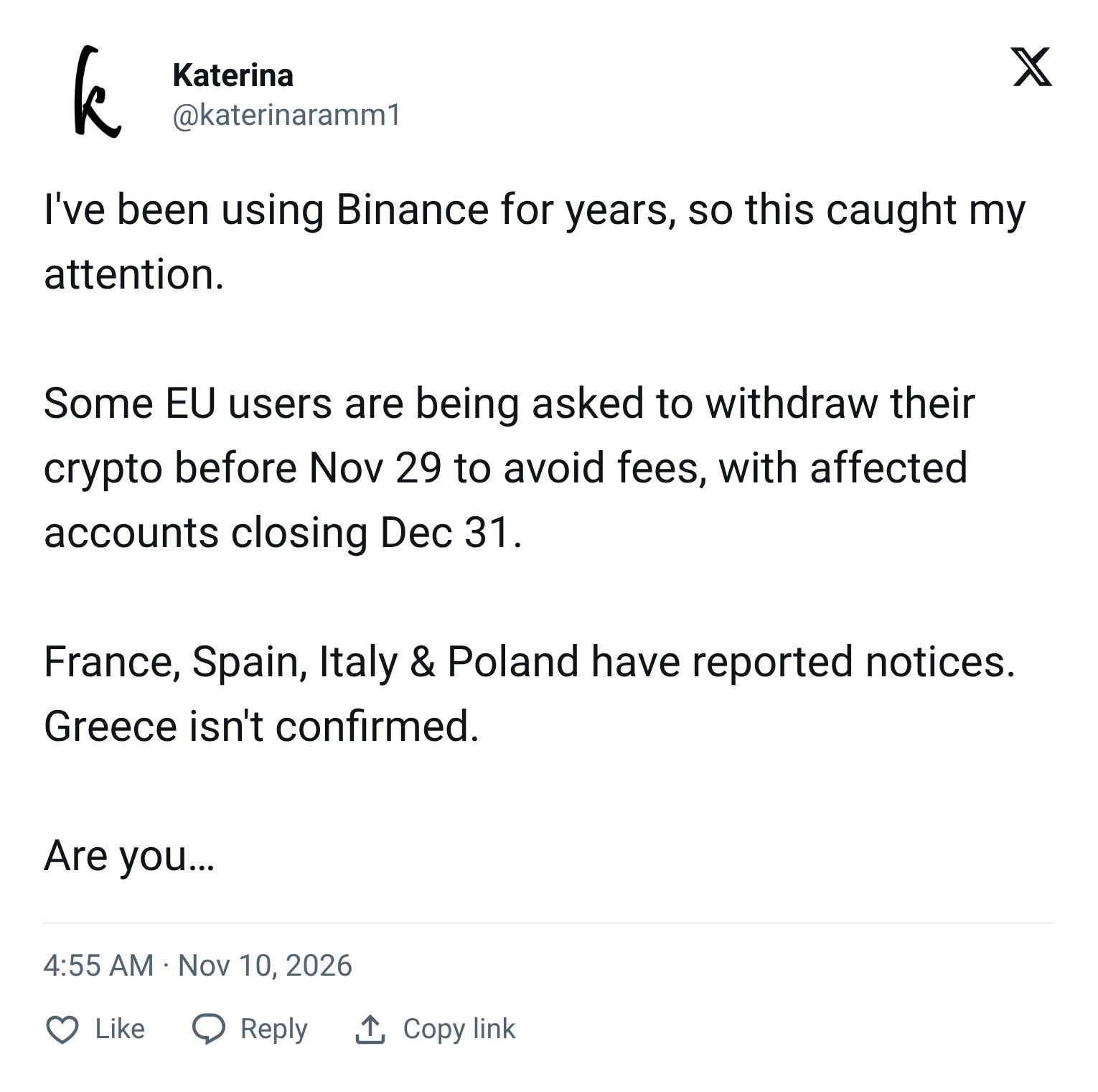
And yeah when most of what you do with crypto happens inside an exchange app, it’s easy to forget what happens outside it. But coins can go straight from one wallet to another without an exchange ever getting involved.
That used to be the thing people found remarkable about crypto. Put a CEX back in the middle and you’ve added dead weight with the power to say no ☠
North Korean hack groups going full memecoin dev
If there’s one thing that memecoiners constantly complain about it’s constant lack of fresh liquidity. And even if there was plenty of it, who has time to question where it came from, when there are juicy PnLs to share? 🤳
Well, the trenches got their liquidity. Some of it came courtesy of North Korea 👇
Blockchain investigators at Elliptic traced around $430,000 in stolen NEAR from the Binance hack through six homemade memecoins. The people moving the funds had made the coins themselves 🪙
They put real effort into making the coins look like the sort of thing people might actually trade. One had a monkey in a pink bow. Another had a duck in front of an American flag. Then there was the one with Elon Musk under an “Elon 2028 President” banner, in other words, if you saw any of these on a list of new tokens, you’d have absolutely no reason to think they were stranger than the ones above and below them 🤷♂

How it was done was really simple.
Wallets holding stolen NEAR bought the memecoins through liquidity pools. Other wallets controlled by the same operation sold the coins back into those pools and took out NEAR. If you only looked at the wallets on the receiving end, it could look like they’d made a pile of cash trading some dumb new memecoin 🧠
In reality, almost all the trading came from the operation’s own wallets. On one token, outside buyers accounted for less than 1% of the volume.
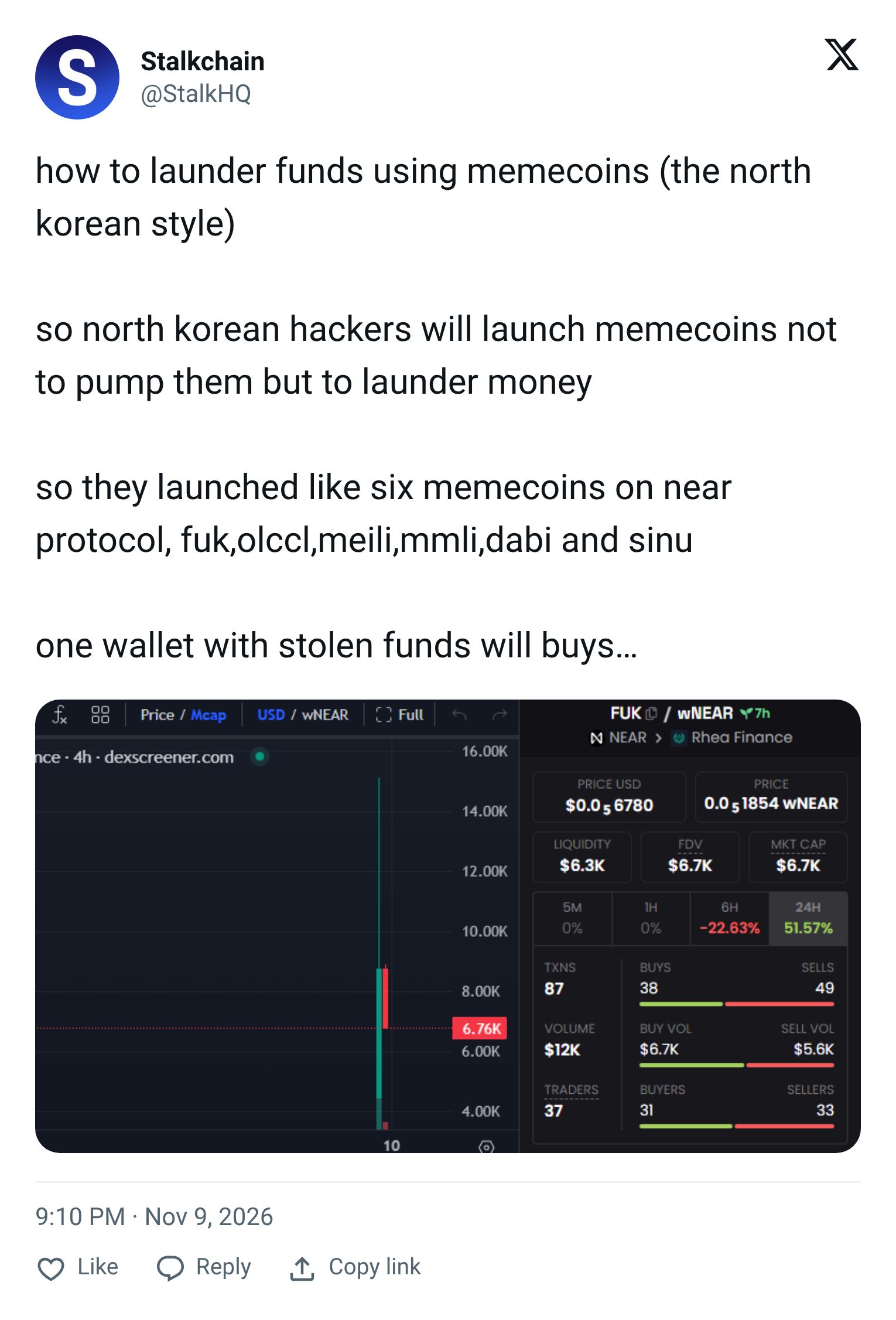
All six coins stopped trading by November 8. The extra swaps made the trail more annoying to follow, but Elliptic could still trace the funds. The best the scheme could buy was time. A duck in front of a flag doesn’t do much once somebody starts looking at onchain data 🕵

Spare a thought for the poor bastard who saw all that volume and figured they were early. They thought they’d finally found that 10000x but instead landed a small unpaid role in somebody else’s alibi 😢
Other worthy reads
“The Battle for the Long Tail: Is Hyperliquid Losing Ground?” - matteo:

“How Pumpfun is killing the trenches” - Sparsity:

“The Antifragile Internet” - Jay Yu:

MEMES


That’s it for this week, frens.
If you enjoyed this edition, share the newsletter with someone who would enjoy it too. It only takes a few seconds and helps more people discover W3OF without us having to beg an algorithm for attention 💜
That’s us for this week. Stay flexible, keep your convictions on speaking terms with reality and we’ll see you next Friday.
Yours, The 🔥 Team
