


GM, frens! ☕️
Here’s your 30 second summary of this week:
🐻 Market this week: plenty of holders, not enough buyers
Holders are sitting tight and DeFi finally had a good day, but analysts still can’t tell whether crypto has found a bottom or just stopped falling for the weekend [here]
🤓 What if the math gives out before quantum computers get here?
AI research has put some old security assumptions back up for debate, but breaking RSA and breaking the signatures that protect a wallet are two very different claims [here]
🔥 Ambire gives its second Ice batch a Black Friday price
Ambire is taking $40 off 30 Ice hardware wallets for Black Friday. A $10 deposit reserves one at $119 through Cyber Monday or until all 30 are claimed [here]
🎥 FTX on Netflix: How Sam became the underdog of his own scam
Netflix had a real feud and an $8 billion fraud to work with. Former FTX staff and crypto viewers are asking why it needed to invent a scene that made SBF look bullied [here]
💰 Who sold Ansem’s coin? A $2.57M wipeout
Solana trader Ansem says someone broke into his wallet and sold $1.5 million worth of the coin named after him, sending its price down 57% in under an hour [here]
Plus:

And if you like our newsletter, we’d love for you to share it with someone who’d enjoy it too:
If you’re still staring at the charts after all that, come hang out in our Discord.

Market this week: plenty of holders, not enough buyers
Calling the bottom in October has one obvious downside… people can still read what you wrote in November.
Back in October, Galaxy’s head of research Alex Thorn made a reasonable case that the worst was over:
BTC was trading below its average price for the previous 50 weeks. In September it finally climbed back above that line and stayed there long enough for the recovery to look convincing.
In previous cycles, by the time that happened, the bear market low was already behind us. Thorn put June down as the likely bottom. He also told clients what would make him reconsider, which is rather more than you get from a guy spamming rocket emojis 😬
The funny thing is that by this week, anyone who’d ignored the experts and held on to their DeFi bags finally had a decent day 😉
The recovery lasted seven weeks.
Price slipped back below the 50 week average in early November and lost the 200 week average the following week. By November 21, BTC had traded as low as $55,100. Galaxy’s original test allowed a month to recover the first line, but getting there would have required a gain of nearly 22% from the November 22 close. On Tuesday, Thorn told clients he wasn’t waiting around for that.
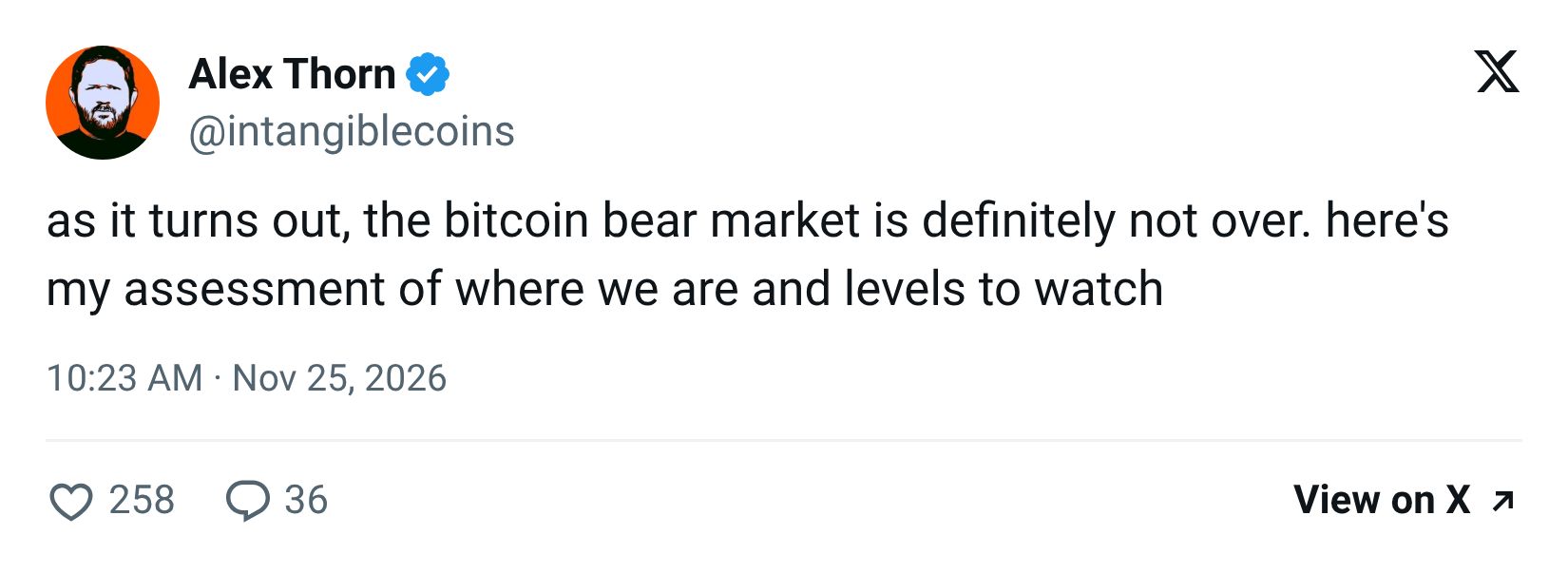
What he withdrew was the call that June had been the bottom. There’s a distinction worth keeping here because the worst number in Galaxy’s report, $28,200, is considerably easier to post than the explanation underneath it 🤔
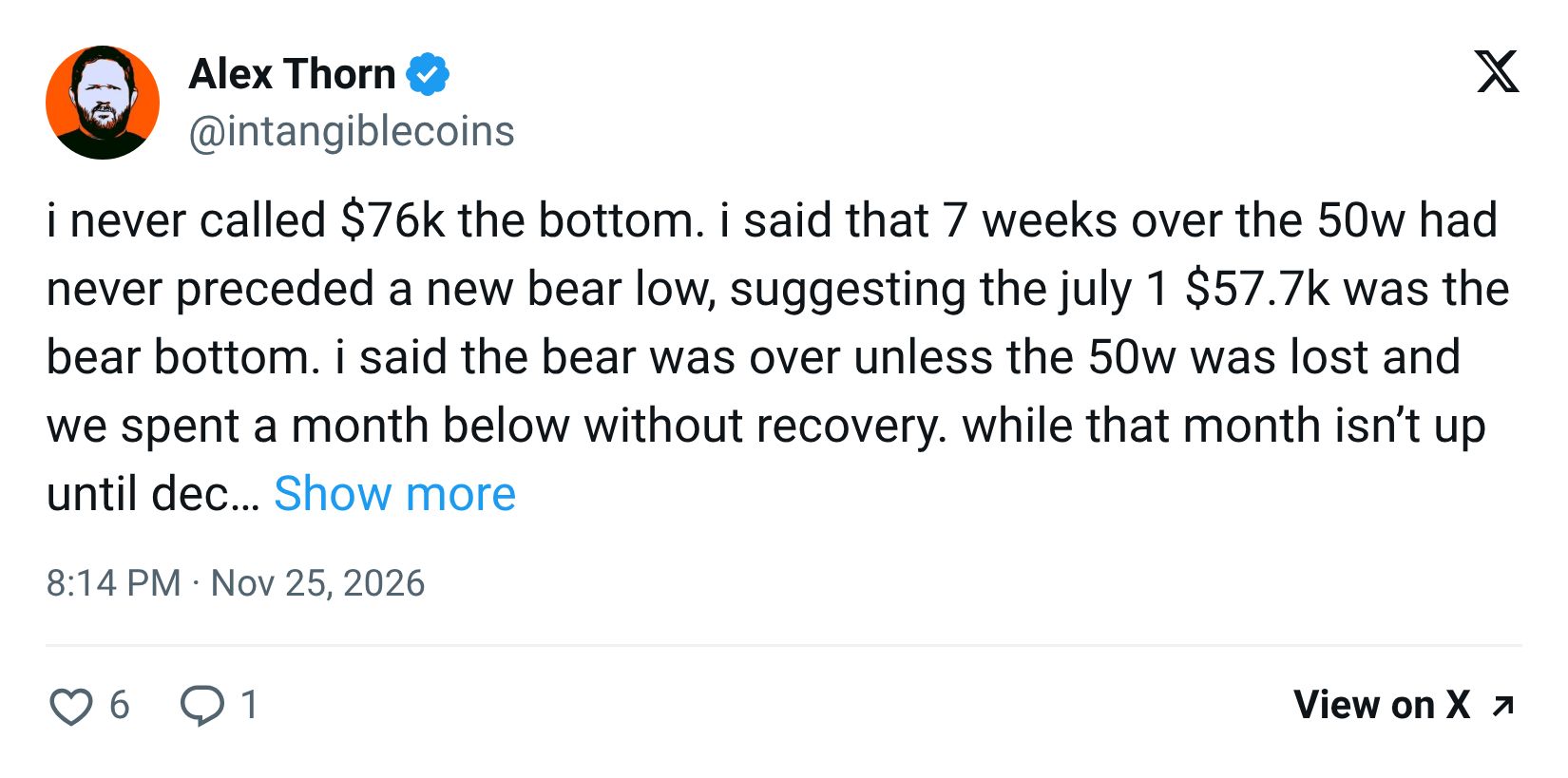
Galaxy looked at seven earlier cases where a low had held for at least 60 days, price had recovered at least 20% and then the market closed below that old low anyway.
The smallest further fall was 17%. The median was 52%. Apply those figures to June’s closing low of $58,525 and you get roughly $48,500 and $28,200. When Galaxy published its note, the June closing low still held 👇

Where the experts actually disagree is over how useful those old bears are.
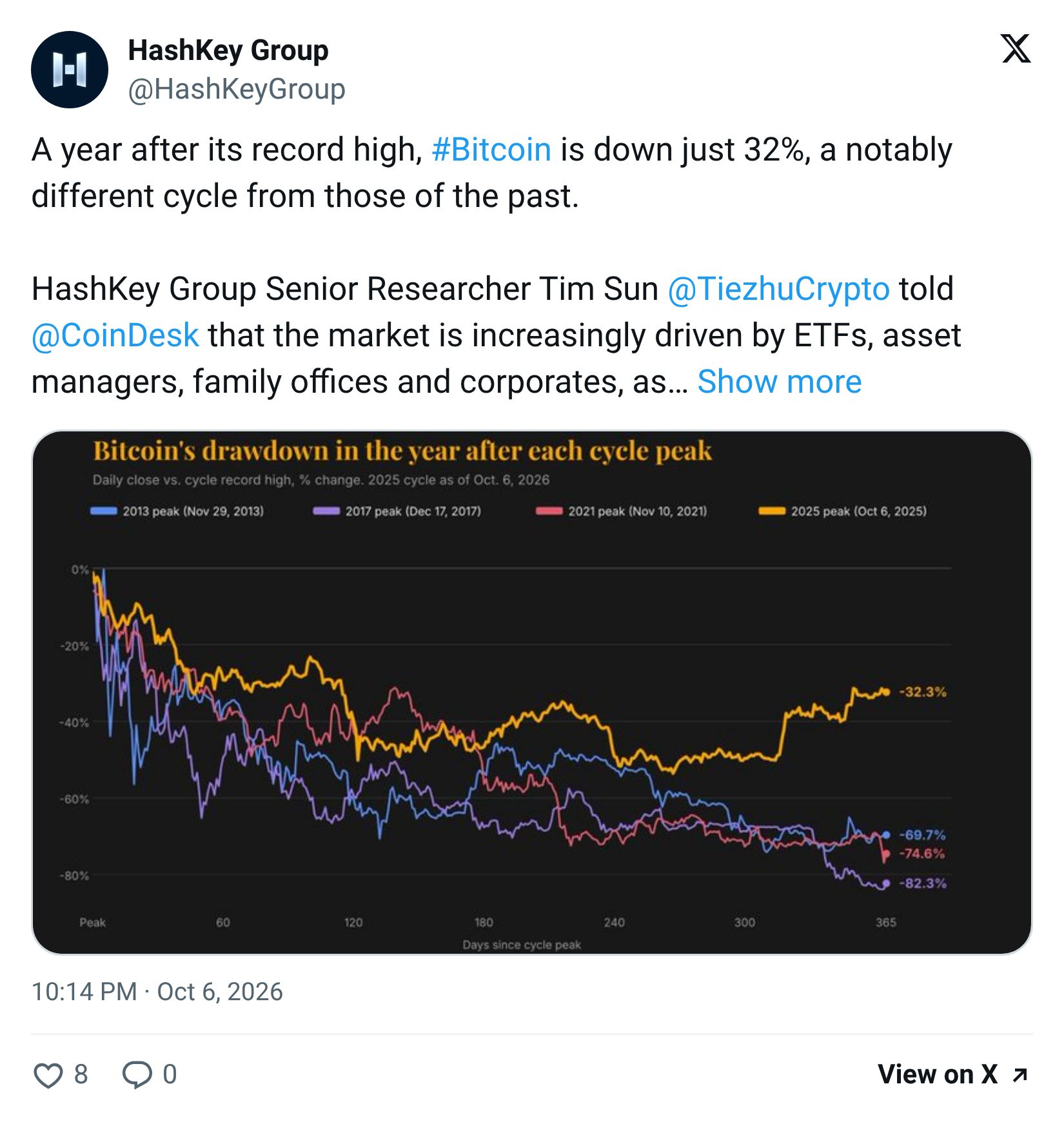
At 412 days from the peak, this one had already lasted longer than the four Galaxy compared it with. Yet the decline was about 53%, against 77% to 93% in those earlier markets.
HashKey researcher Tim Sun offered a decent reason those numbers might never line up neatly again. A market where retirement accounts can buy BTC through an ETF has a different set of buyers from the one that followed the old four year cycle. Those people have interest rates to think about and other assets they can own. A longer wait doesn’t automatically mean a deeper fall:
Meanwhile, the holders are mostly sitting this one out
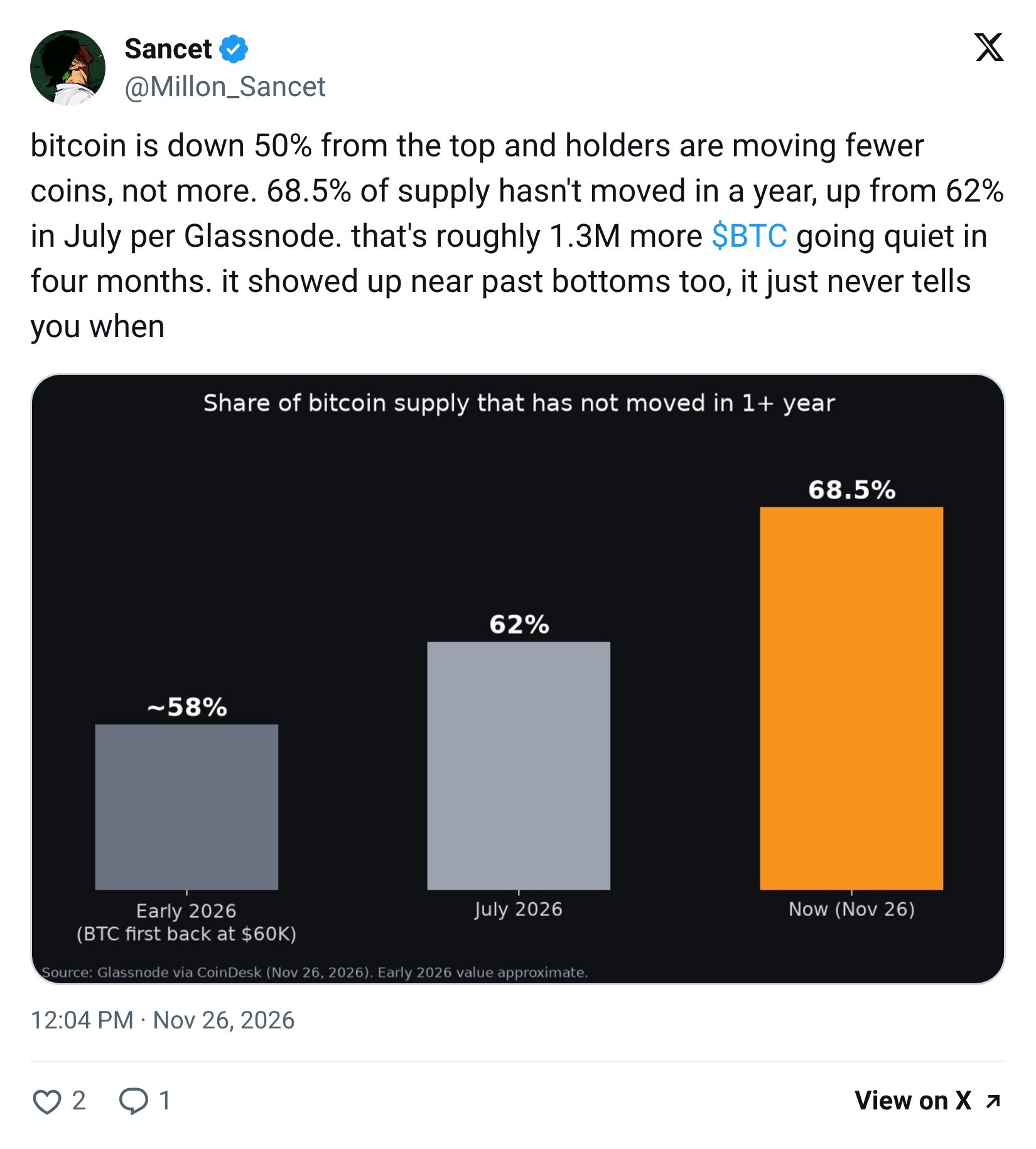
Glassnode found that 68.5% of circulating BTC hadn’t moved onchain for at least a year, up from 62% in July.
Something similar happened as previous bear markets worked toward a bottom. During the good months older holders move coins they’ve sat on for ages 🐻
During the bad ones, more of those coins stay put long enough to turn a year old. What’s particularly interesting this time is that some coins last moved near the top and haven’t budged through a fall of roughly half.

That gives the bulls something better to work with than a date on a calendar, although it tells them more about the sellers than the buyers. A wallet that hasn’t moved since last November looks exactly the same whether its owner would happily buy more today or would prefer never to open the app again 🤓
The US Thanksgiving gave us a look at the people who were trading.
Over 24 hours, 93 of the 100 assets in the CoinDesk 100 gained. Its DeFi index rose 6.3%, roughly twice BTC’s 3.2%
ETH rose while open futures positions shrank, suggesting some of the buying came from traders closing shorts. They only needed to believe the fall was over for the afternoon. That’s a much cheaper opinion to hold than believing the bear market is over for good.
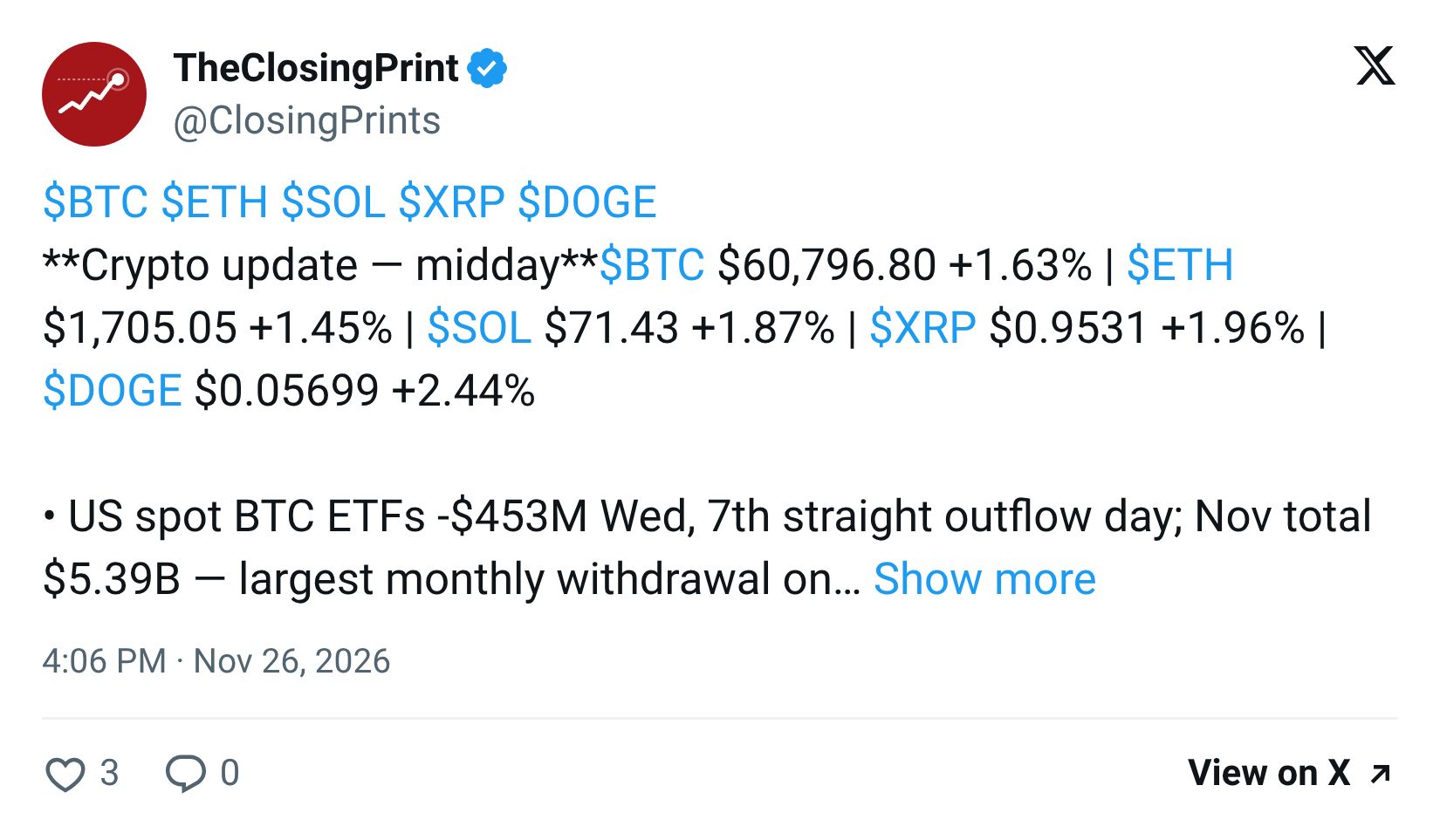
The US spot BTC funds had just posted a seventh straight day of withdrawals, taking November’s net outflows to about $5.39 billion.
For anyone trying to reconcile a green screen with a bearish research note, that’s where to look next. The guy buying back the ETH he shorted yesterday has done his bit but true recovery needs someone who actually wants to keep it 🍄
What if the math gives out before quantum computers get here?
Your portion of the obligatory weekly cryptography scare:
A lot of online security depends on certain math being cheap to implement and ruinously expensive to crack, but everybody actually gets to know how the system works 🔨
What keeps it secure is that nobody knows a shortcut good enough to use. Or knew. For all this time the most familiar threat to that arrangement was a powerful quantum computer.
The new concern is that smart enough AI could help some guy find a better algorithm for an ordinary one 🤖
Why people took the rumor seriously
Both OpenAI and Anthropic have been releasing claimed proofs of difficult mathematical results. Some come with formal proofs that other software can check, so a mathematician doesn’t have to take a chatbot’s word for how clever it’s been 🥸
One example this week concerned matrix multiplication, a problem researchers have worked on since the 1960s. This doesn’t give someone access to a wallet right away, sure, but it changes how casually you can dismiss the suggestion that an AI lab with enough resources might find something mathematicians have missed for decades.
That was the context when computer scientist Scott Aaronson said several sources had convinced him the big labs were sitting on significant unpublished cryptography results. The bit everybody liked sharing was “virtually certain” 🤖
The bit worth reading was what he was certain about. He believed there was something substantial. He didn’t know exactly what it was, and explicitly pushed back on people treating his comment as confirmation that a lab had broken RSA. Neither company had produced a public demonstration of that in the reporting behind the claim.

Charles Guillemet, Ledger’s outgoing CTO, laid out what he’d been hearing.
One rumor concerned a fast way to factor large numbers. Another concerned elliptic curves. A third involved a mathematical problem called Ring-LWE, part of a family of ideas used in some cryptography designed to withstand quantum computers. Those would be very different discoveries. By the time they reach somebody who only wants to know whether their ETH is safe, all three can sound like the same headline.
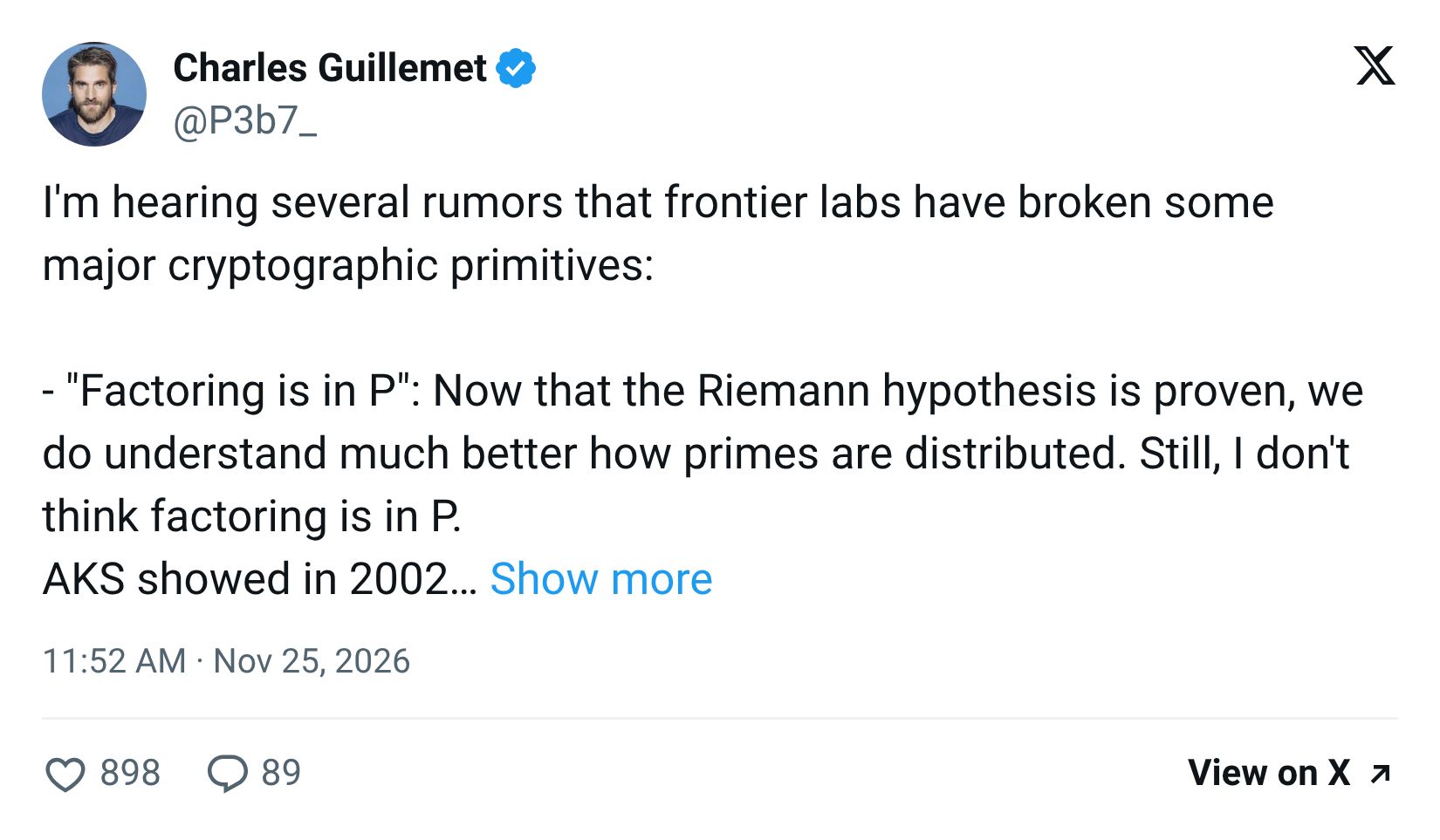
Start with factoring. RSA depends on how hard it is to work backward from a huge number to the two primes that produced it. A practical shortcut for that job would be serious trouble wherever vulnerable RSA keys were still in use.
But even an impressive improvement in the mathematics can be useless against real keys. Google published factoring research this week that Aaronson described as theoretically significant without being a practical threat to encryption. For the people operating the systems, how big a key, on what computer and in how much time is most of the story.
For crypto holders, the elliptic curve rumor is the one that hits closer to home. Bitcoin and Ethereum use elliptic curve signatures to establish that the person authorizing a transaction has the right private key 🔑
A practical break in the curves those networks actually use could undermine that check. The ability to factor a big RSA number doesn’t get you there. Nor would a flaw in a particular proposed replacement prove that every other replacement was broken, though this still is a serious issue worthy of thought.
In the meantime, Ethereum researchers have recommended Keccak-256 as the foundation for proposed cryptography built around hashes.

Ethereum already relies on it for addresses and parts of its state. It has also had close to two decades of people trying to find something wrong with it 🤓
The recommendation is part of a longer effort to reduce Ethereum’s dependence on elliptic curves and there’s a useful bit of engineering judgment in that choice.
After a week of hearing what somebody might have discovered in private, at least Ethereum wants to build around something people have been allowed to pick apart in public 🫡
Ambire gives its second Ice batch a Black Friday price
If you bookmarked last week’s Ice preorder and forgot about it, your procrastination might save you another $40 👀
For Black Friday, Ambire has set aside 30 devices from its second batch at $119 instead of $159. Ice is the open source hardware wallet built for Ambire and Safe accounts. It shows you what each action in a transaction does on the device itself, before you sign.

A $10 deposit reserves your spot, with the discount applied when you pay the balance before delivery. The offer goes to the first 30 reservations and ends Monday, November 30 at 11:59 p.m. UTC unless all 30 go sooner. Ambire expects delivery within six months, so this one’s for your Safe rather than the Christmas tree.
FTX on Netflix: How Sam became the underdog of his own scam
“Somewhere in Hong Kong there was an FTX employee who couldn’t afford a ticket home because he’d kept his money on the exchange he himself worked for. A colleague had to buy it for him” -
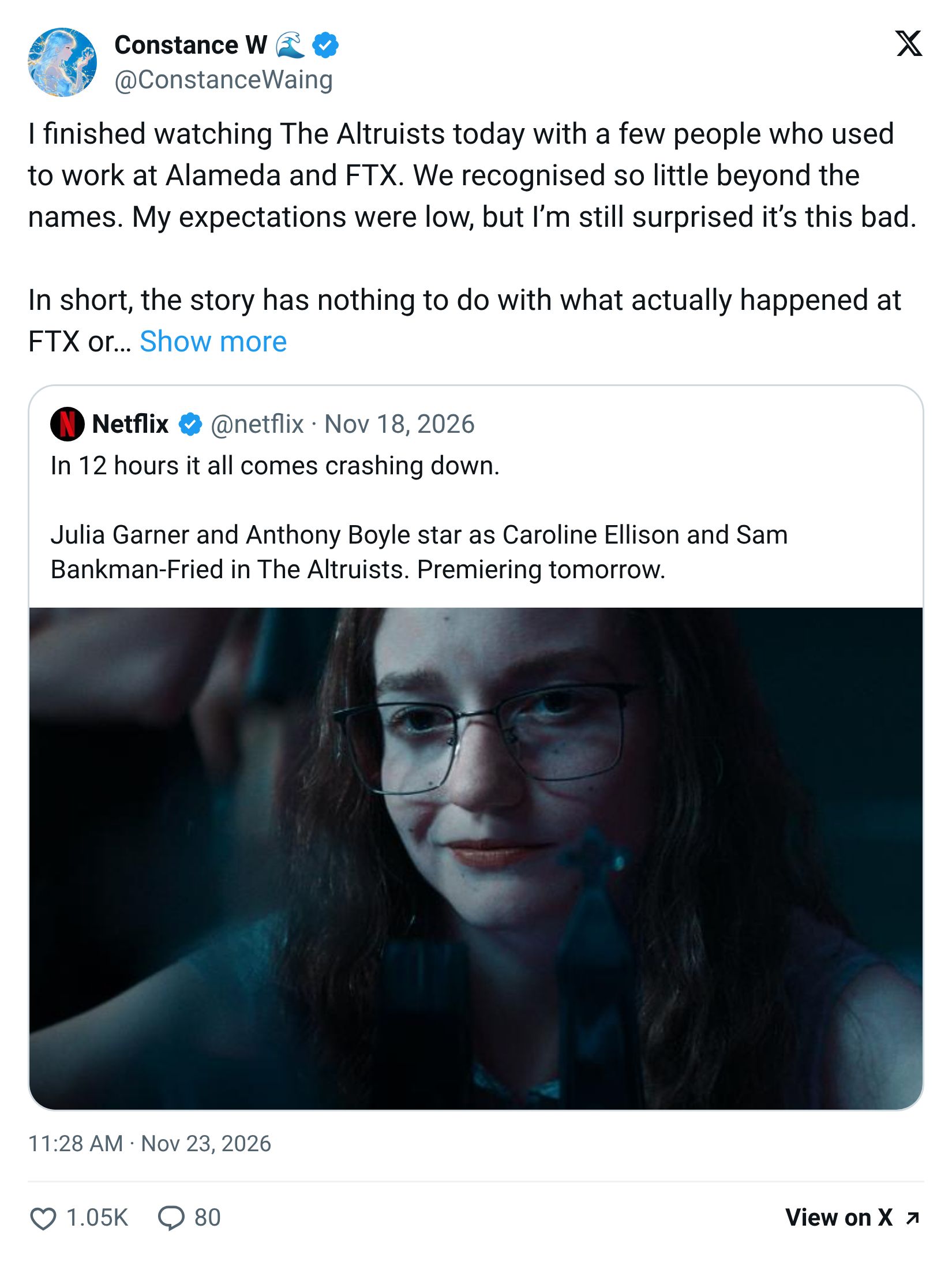
- that detail comes from former FTX chief operating officer Constance Wang, who watched Netflix’s take on the collapse with people who had actually worked there. You can see why they might have come away with rather different notes from the average TV critic. They knew who had to borrow the airfare.
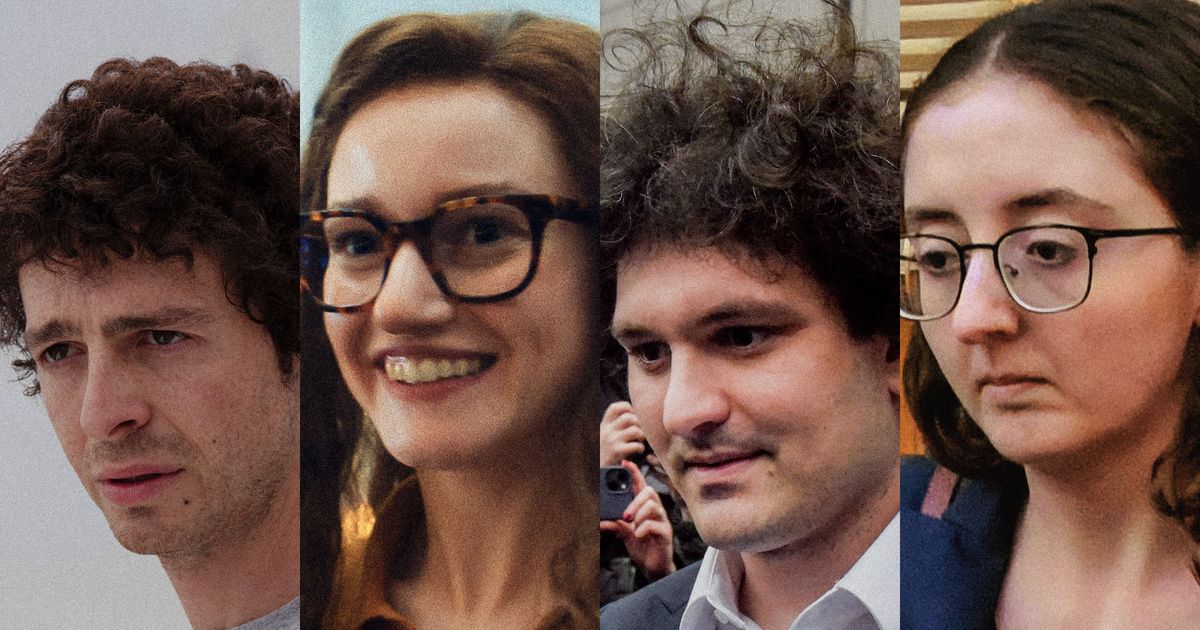
Netflix’s The Altruists follows Sam Bankman-Fried and Caroline Ellison from ““““effective altruism””””” to the collapse of FTX and Alameda Research.
There’s a relationship at the center of it, which is fair enough. Ellison ran Alameda, Sam founded both businesses and the two dated. Spend enough time with those two as a couple, though, and a funny thing happens to an $8 billion scam… you start looking for the bad influence who led these poor promising young people astray 🙏 😢 🤡
In episode four, Netflix sends them round the back to meet him.
In the scene, Binance founder Changpeng Zhao is unhappy with the return on his early investment in FTX. He threatens the business and wants Alameda to be able to see FTX customer orders early enough to trade ahead of them.
Sam and Caroline look like two kids who’d very much like a lift home. If you came to the series knowing next to nothing about crypto, you’d have a perfectly good reason to think the founder of Binance had taught the founder of FTX how to scam his customers. The writer put it on screen 🙄
Graham Moore, who created the show, later acknowledged in Vulture that there’s no evidence CZ made that demand. Which is quite a thing to leave for the companion reading. CZ objected to the clip. More interestingly, so did people with no particular reason to take his side 🤔
Vitalik questioned the exaggerated accent:

Wang said the back door meeting played on an Asian mafia stereotype. Crypto commentator Stacy Muur picked up on what it did for the people sitting opposite him: the more threatening CZ looked, the more innocent Sam and Caroline got to look just by sitting there 🤦♂
What makes the invention so odd is that the real CZ gave the writers plenty to work with. In November 2022, after reporting raised questions about how much of Alameda’s balance sheet depended on FTX’s own token, CZ publicly announced Binance would sell its remaining FTT. Customers rushed to withdraw.
Binance briefly considered buying FTX and then walked away. Anybody who remembers those few days remembers refreshing their phone to see what these guys would say next. He had considerable power over when people found out how much trouble FTX was in. The customer deposits had already been spent though 🤷♂
Not to mention actual FTX trial and how much SBF himself said and what was admitted by his team who all ratted him out to FBI.
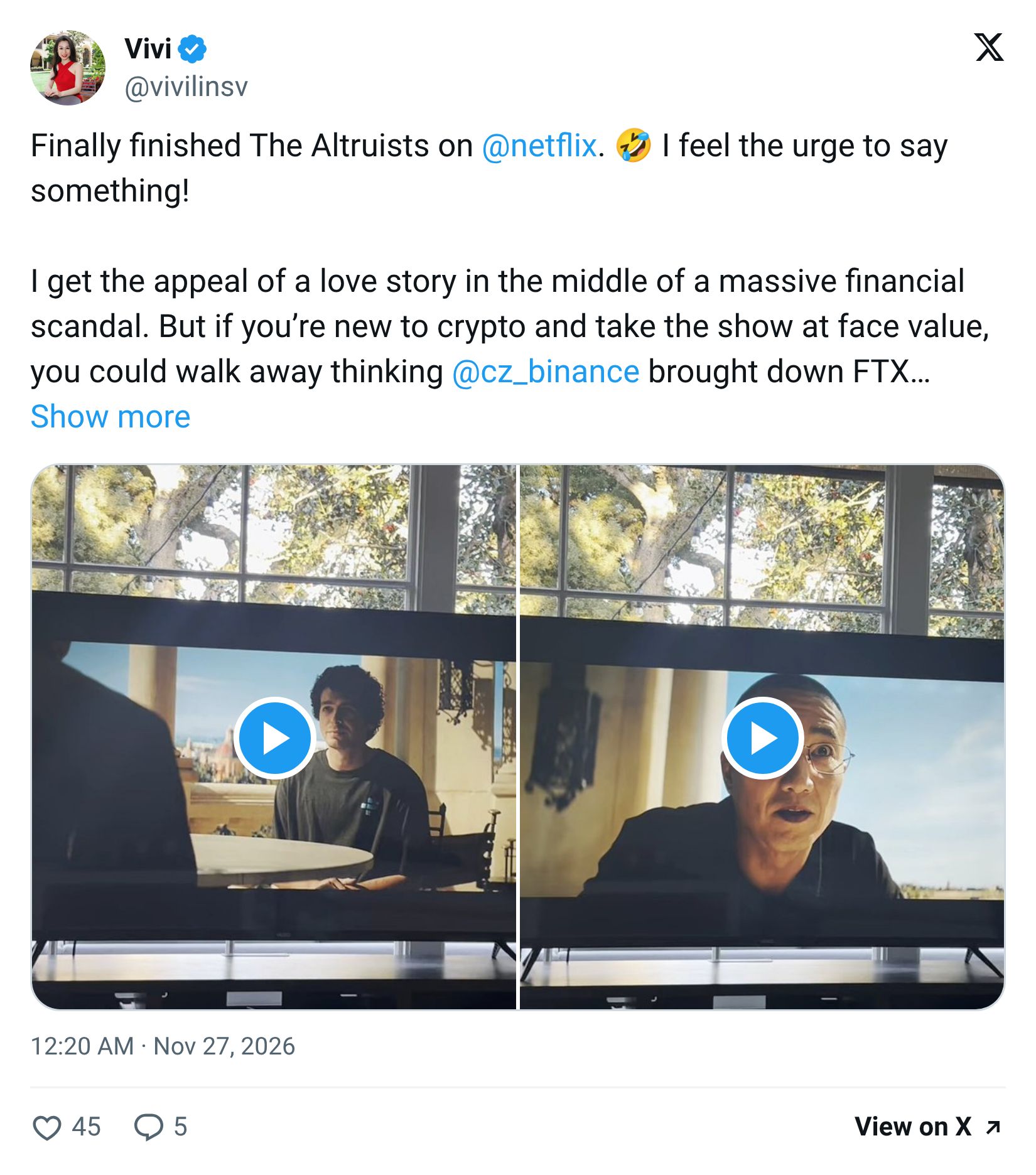
CZ also pleaded guilty to failing to maintain an effective program against money laundering at Binance and served a four month sentence. His actual record is pretty much open to criticism without giving him a writing credit on somebody else’s scam.
Sam told FTX customers their deposits were kept safe and separate. He then used customer funds to cover Alameda’s debts and finance investments and political donations 🤪
Ellison pleaded guilty and testified against him. A jury convicted Sam on seven counts. He got 25 years 🔨
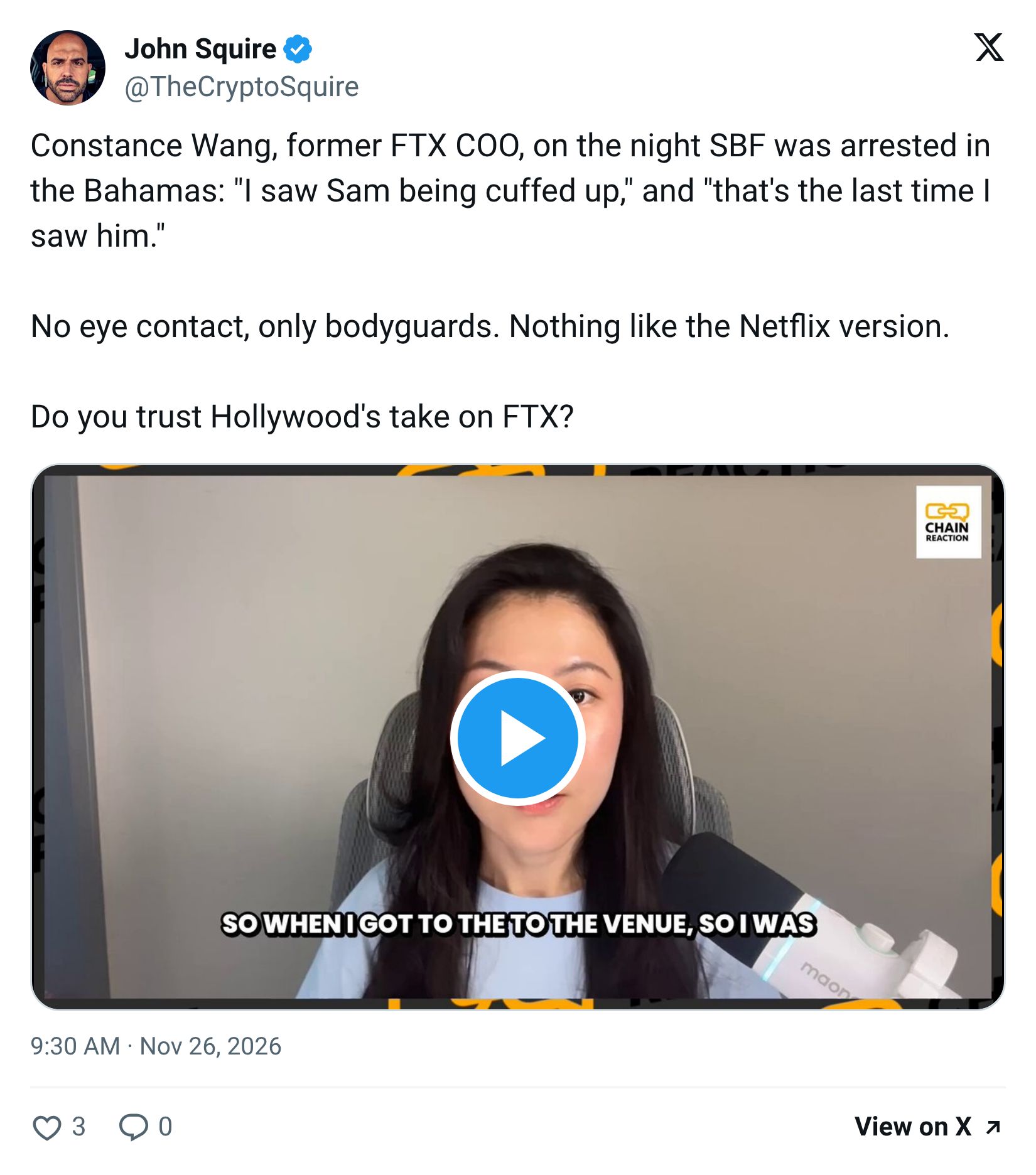
The show also invents Rachel, a junior employee who discovers the missing billions.
Moore explained that he thought somebody lower down must have seen something they weren’t supposed to, though he couldn’t establish who or under what circumstances (in reality they never cared until it was too late 😐 )
So the audience gets an invented employee to discover the fraud and an invented conversation to explain how the people at the top might have been pushed toward it.
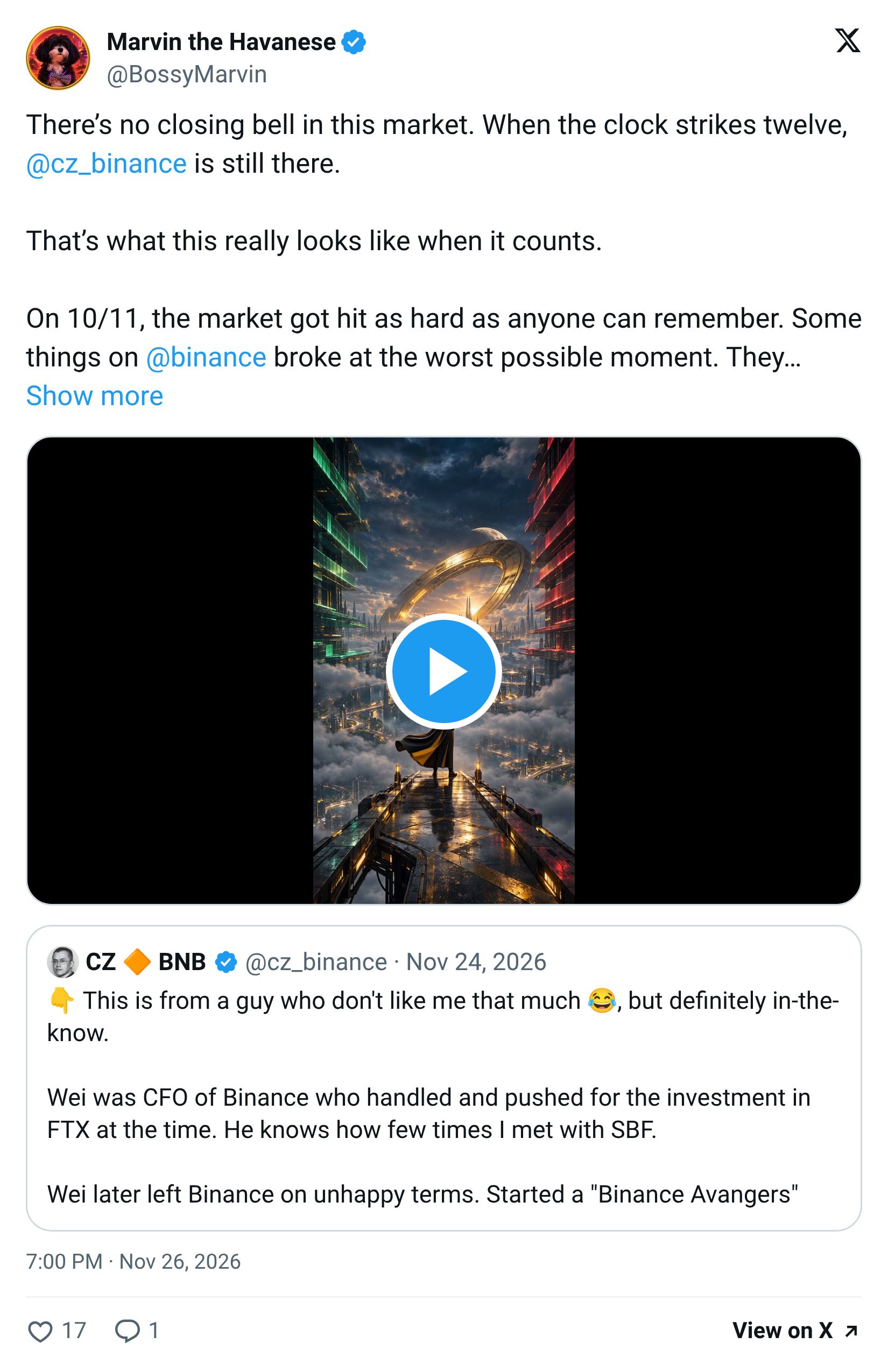
Wang stayed in the Bahamas after the collapse because she wanted an explanation from Sam. What she remembers getting was “I’m sorry, I f***d up” - that was about as much insight as one of his own executives could get out of him. The people who paid for the whole operation got an apology and Sam got a cool character study 🤐
The people who lost money at FTX have a better reason than most to care about this.
Sam got as far as he did because people gave him credit for what he said he wanted to do with his fortune instead of asking whose money he was using. Netflix had the benefit of a whole trial and still found his intentions more interesting than his customers.
Four years later, he’s in prison and his BS self-promotion propaganda works better than it has any right to. The only question is “why the hell” 🤢
Who sold Ansem’s coin? A $2.57M wipeout
One of the selling points of the whole creator coin experiment is that you know exactly who you’re backing. That sounds great until his wallet starts selling and knowing the guy’s name turns out to be the least useful bit of information.
On Tuesday morning, memecoin traders watched a Solana wallet linked to Zion Thomas, better known as Ansem, unload his holdings 💸
Ansem made his name trading Solana memecoins. He also cofounded a trading terminal called Bullpen and has a coin named after him called “The Black Bull”, which trades as $ANSEM. So when that wallet began selling $ANSEM into a market full of people who had bought it partly on the strength of his reputation, plenty of them took the sales personally.
The first accounts tracking the wallet could see what was happening considerably sooner than they could explain it.
Lookonchain initially asked whether Ansem was dumping or had been hacked.
CoinDesk later counted 877 sales worth about $2 million, including roughly $1.5 million worth of $ANSEM 💰
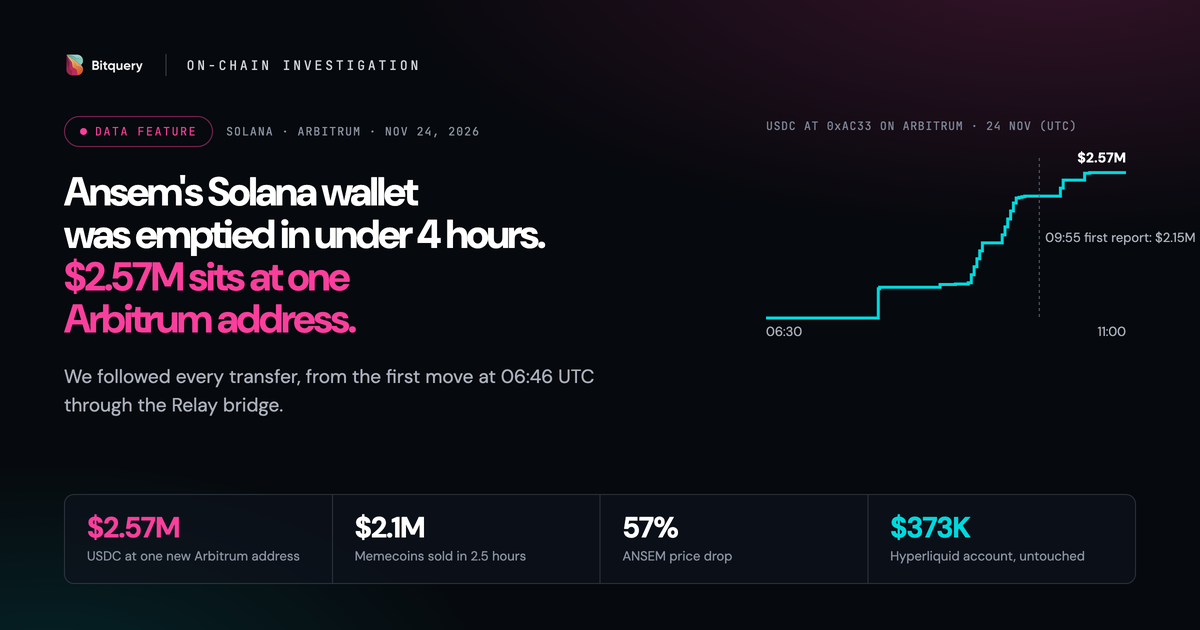
Bitquery’s investigation put the fall in the token at 57% in under an hour, with its market value dropping from about $15.2 million to $6.3 million. That doesn’t mean anybody cashed out the roughly $9 million difference. It means the buyers willing to take those sales were offering a lot less by the end of the hour.
What made people suspicious
Ansem said his Pump wallet had been hacked. He’d imported its Solana private key into his Bullpen account and suspected somebody had gained access there. One detail fit that explanation: his separately keyed Hyperliquid account still had about $373,000 in it. Whoever was selling hadn’t simply walked off with everything publicly associated with him 🤷♂
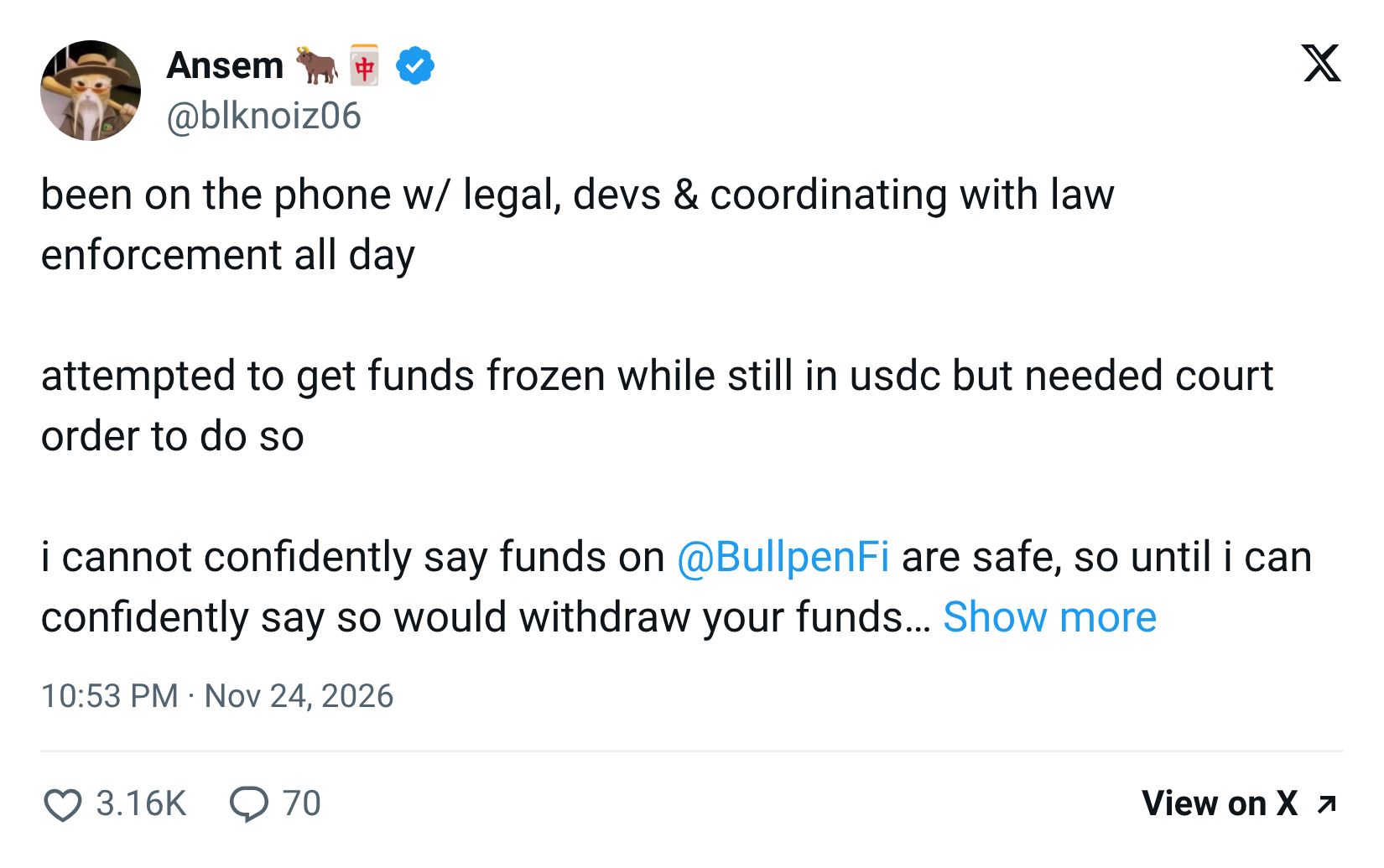
Then an onchain analyst posting as MLM raised a specific objection. About an hour before the selling began, a previously inactive wallet had funded the address that later received the proceeds 🕵♂️
MLM said they had labeled that older wallet as Ansem’s a year earlier. From the analyst’s point of view, this looked less like a stranger picking a fresh destination and more like an address with a prior connection to the man claiming to have been robbed. You can understand why that caught on extremely fast:
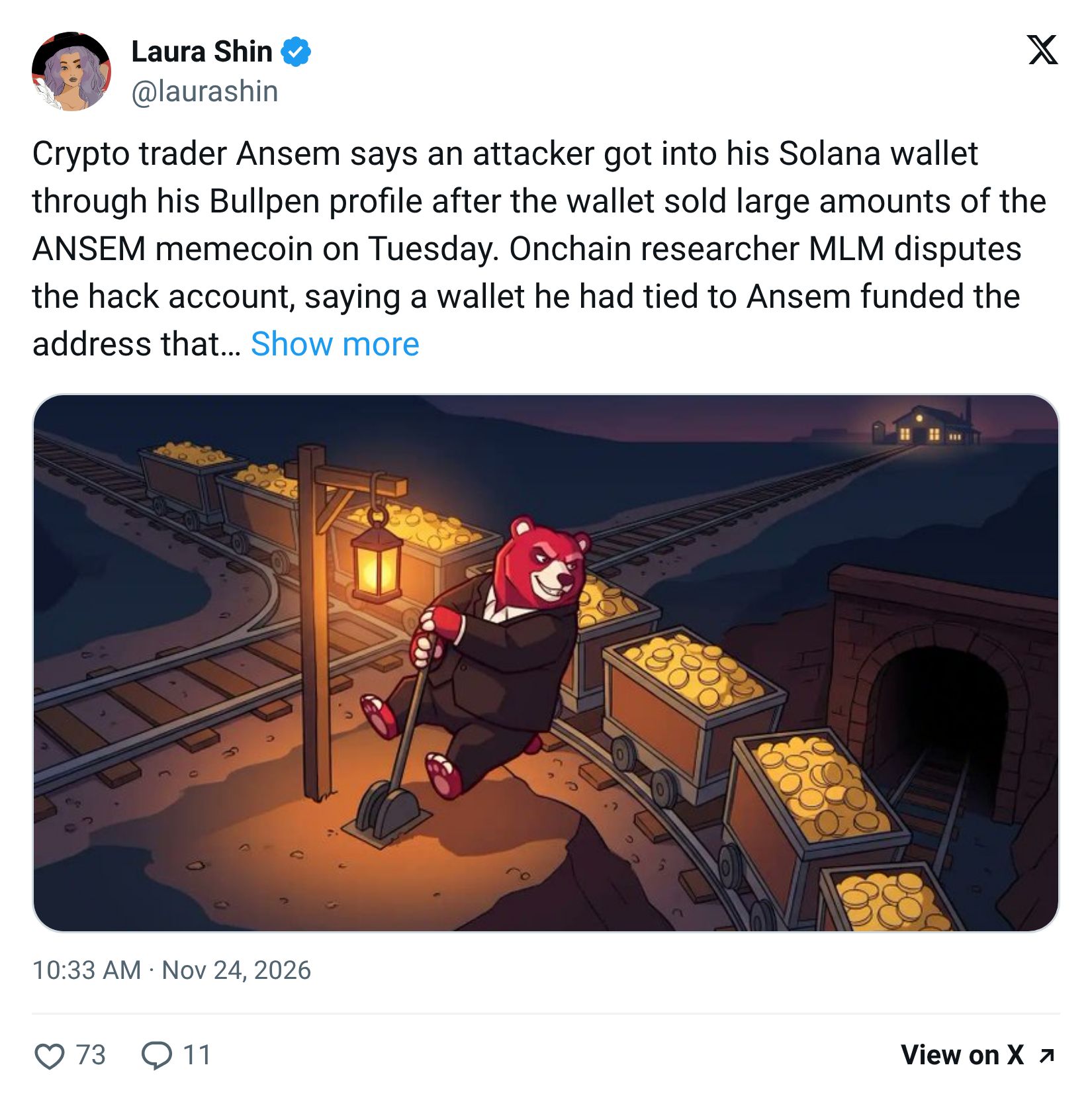
Ansem denied making the sales. His response was that if somebody had access to his Bullpen profile, they could potentially use more than one wallet in it.
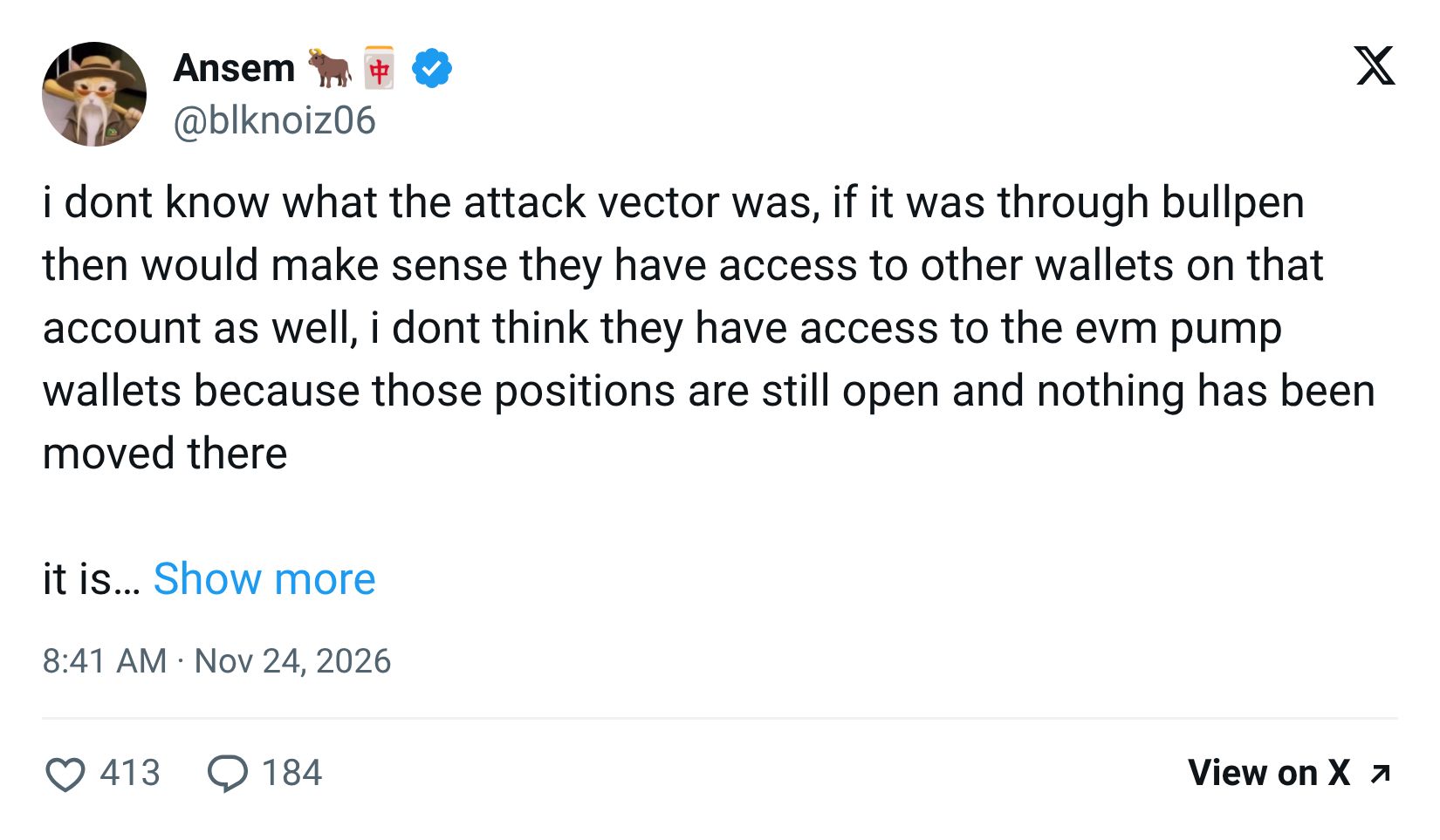
The $2 million in reported sales and the $2.57 million people saw on Arbitrum are different figures for a good reason. The Solana wallet already held USDC.
Bitquery traced that existing balance along with proceeds from the memecoin sales to the same new Arbitrum address. Its first report stopped around noon on Tuesday, when the funds were still there. A fair bit of the argument online was based on that snapshot 📷
By that evening, according to Bitquery’s updated investigation, the $2.57 million had been converted into 42.24 BTC and divided among four new addresses. The researchers also linked activity involving 14 other accounts to the same operator.
A separate Ethereum wallet sent its entire $1.58 million USDC balance to the same address on Ethereum, where it was exchanged for 951 ETH. Most importantly for the original argument, Bullpen itself said 18 to 19 accounts had been affected.
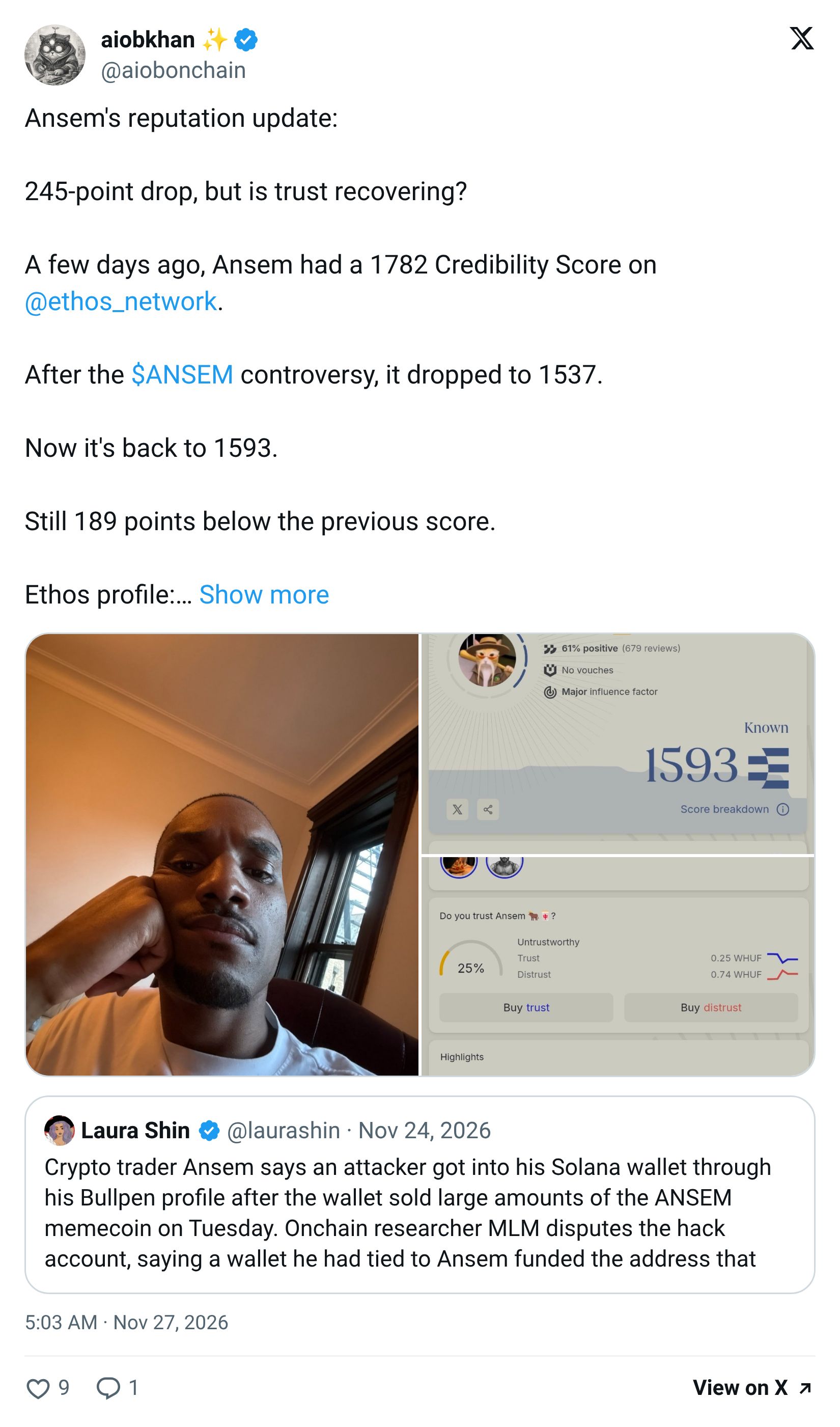
There’s a reason this became such a nasty argument so quickly.
Holders had to decide what they believed while somebody else was already selling. They bought a bet on Ansem’s reputation and ended up underwriting the security of his trading account for free 🤔
Other worthy reads
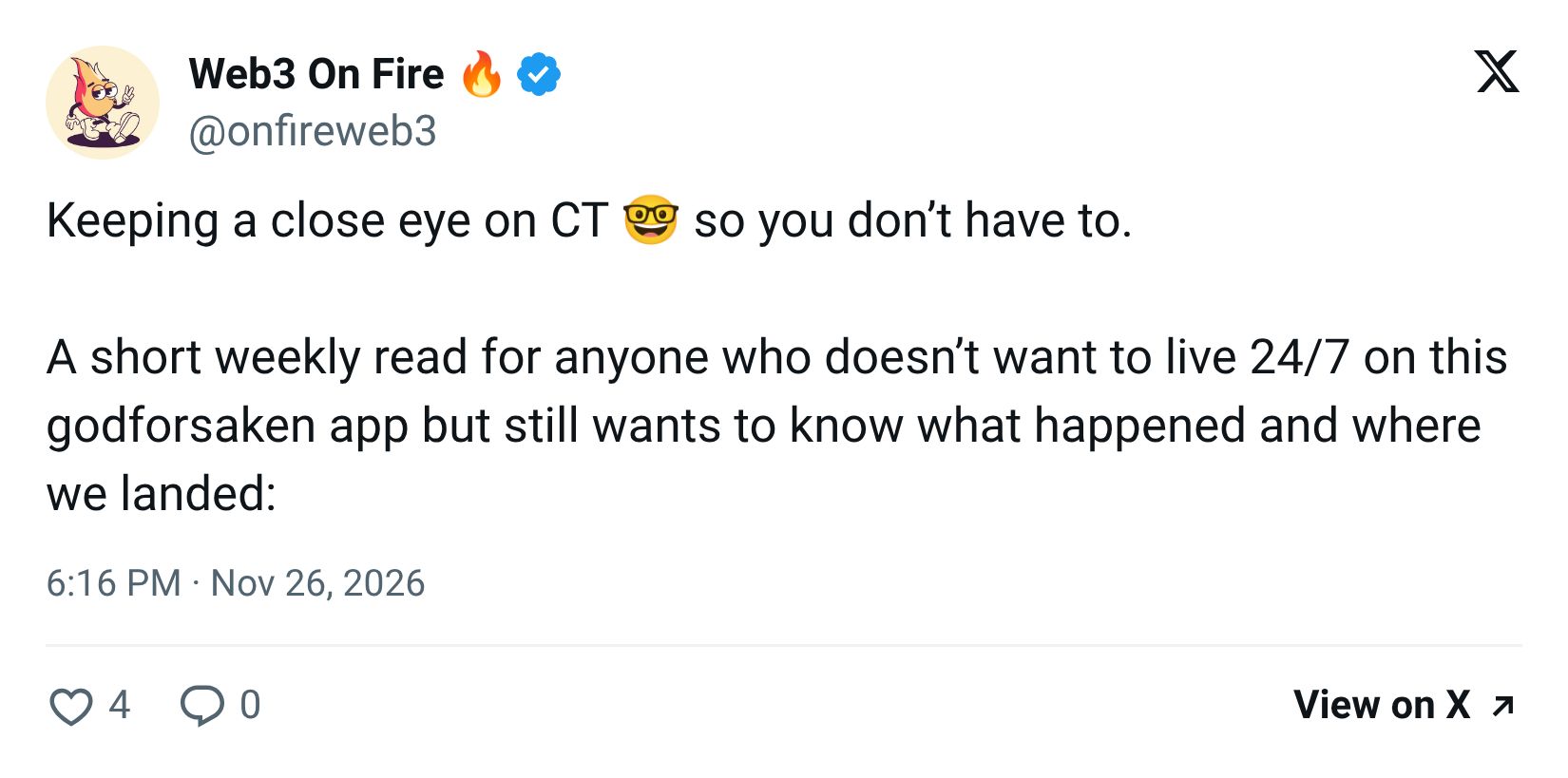
“Weekly CT Overview | Week 48 | November 20 to 26” - the W3oF team:
“A shallow dive into open-source chip design” - Vitalik Buterin:

“State of Digital Assets 2026” - Four Pillars:

MEMES


That’s it for this week, frens.
If you enjoyed this edition, share the newsletter with someone who would enjoy it too. It only takes a few seconds and helps more people discover W3OF without us having to beg an algorithm for attention 💜
That’s us for this week. Try not to turn every five minute candle into a life decision and we’ll see you next Friday.
Yours, The 🔥 Team
