

GM, frens! ☕️
Reliability doesn’t sound particularly exciting, especially in crypto, where everyone wants the newest thing before they’ve finished understanding the last one. But there’s something reassuring about knowing something will simply do what it’s supposed to do, again and again.
The longer you’re around, the more you appreciate that. Hype gets attention, but being able to depend on something is what makes you keep coming back 🫢
Here’s what we’re looking at this week:
🐻 The bear market is getting old
💜 Apps we love
🪙 POAP winds down after 7.6 million badges minted
🤡 CZ says exchanges are safer (and his math is garbage)
🥳 Few and Far founder charged over gambling away $10M of investor money

Drop by our Discord and tell us what’s earned your trust over the years 🤠

The bear market is getting old
The price is hovering around $64,000 after touching roughly $126,000 last October, so the market has become desperate for anything that looks like a floor - one green day starts recovery hype right away, one red day brings another round of “it’s over” and it always repeats 🤷♂
But right now, onchain research has offered something more useful than another arrow drawn over a candlestick 👇
The latest Smart Money report from CryptoQuant shows the largest holders adding BTC, Ether and XRP while prices remain under pressure. And that apparently has happened near the later stages of previous bear markets, although the data stops well short of declaring the pain finished.
Bitcoin whale wallets, excluding exchanges and mining pools, held about 2.87 million BTC in December 2025. Their balances have since climbed to roughly 3.06 million BTC, meaning the group added around 190,000 coins while the market was falling. At current prices, that is more than $12 billion moving into very large hands.
Ether tells an even stronger accumulation story. Wallets holding between 10,000 and 100,000 ETH now control a record 19.6 million ETH. Large XRP orders have also remained present while the token traded between roughly $1 and $1.20, with the order flow suggesting bigger buyers are absorbing sales without chasing the price upward 🔒
Large holders usually have more capital, more patience and a better ability to survive another bad month than someone trying to rescue rent money from a token position. When they buy into falling prices, they remove supply from the market and build positions for whatever comes after the decline 🤔
The valuation data adds more weight, particularly for Ether.
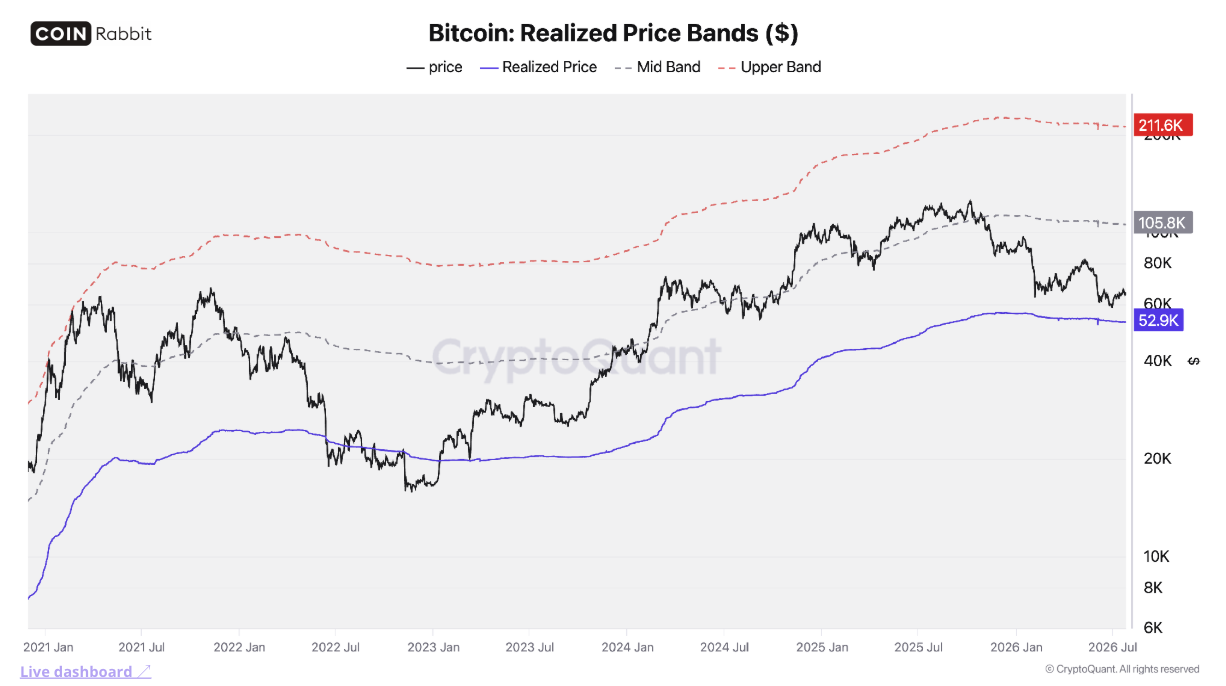
Bitcoin trades well above its realized price of about $52,900, while XRP sits near $1.10 against a realized price around $0.75 🪙
Ether is the odd one out, trading near $1,900 while its realized price remains around $2,450. Simply put, the average ETH unit last moved at a much higher price, leaving a large part of the market underwater on paper.
Realized price has often mattered near bear market bottoms because it approximates the market’s onchain cost basis. Once an asset trades around or below that level, forced sellers and disappointed holders have already done plenty of damage. Ether has reached that territory, while Bitcoin has more room between the current price and the average cost basis.
That is why CryptoQuant still allows for another leg down. Whale accumulation can reduce selling pressure, but it cannot force new demand to arrive next Tuesday. Large holders can also buy too early, sit through further losses and keep adding for months. They have bigger wallets, not access to tomorrow’s newspaper 📰
Another thing is, if smaller holders are selling into large wallet accumulation, ownership becomes more concentrated. That may tighten the available supply and help a later recovery, but it also means the people with the deepest pockets gain more influence over the market during the downturn.

TLDR: the report gives the market a reasonable bullish signal. Whales are finding enough value at these prices to commit billions, Ether is already below its onchain cost basis and the risk looks far better than it did near the top 💰
It shows that the buyers most able to wait have finally started treating the bear market as a sale.
💜 Apps we love
Privacy Pools is one of those Ethereum apps that starts from a problem everyone knows exists, but most people prefer to wave away because the fixes are extremely uncomfortable.
Ethereum is transparent by default. That is great when you want public settlement, open accounting and contracts anyone can inspect. It is less great when every payment, wallet balance and old transaction can be traced forever by anyone with a block explorer.
Privacy Pools is built around a simple idea: people should be able to move funds privately without giving bad actors a free hiding place.
It lets users transact anonymously on Ethereum while using compliance checks to keep illicit funds out of the pool. So the goal is not “privacy at all costs” and it is not “make everything visible so the cops can sleep better” rather it sits in the useful middle: honest users get financial privacy.
Ambire chatted with Privacy Pools on the Ambire livestream this week, and they demoed the upcoming v2.
The upcoming v2 is especially interesting because it focuses on making privacy less annoying to use. The new version brings no extra seed phrase, transfers inside the pool, private pay requests and no fees besides relayer gas.
POAP winds down after 7.6 million badges minted
POAP was one of the rare crypto products that made sense before anyone explained the token standard. You attended something, collected a badge in your wallet and kept a small record that you were there. Nobody needed a yield calculator to use it 🤓
That simple idea became part of the culture.
POAP started at ETHDenver in 2019 with roughly 100 badges for hackathon participants, then grew into a system used for conferences, online events and community milestones. Nearly 7.6 million badges in total were created by more than 46,000 issuers, including Coinbase, American Express, Warner Music Group, Bayer and a long list of crypto communities 🤯
Now the company behind it is winding down. Co-founder Isabel Gonzalez announced the decision on August 3 after more than five years, saying the team could not build a sustainable business without damaging the values that made POAP matter in the first place 😶
The end had been approaching for months.
POAP entered maintenance mode on March 16, stopped bringing in new issuers and ended active dev while keeping existing tools and integrations running.
The company had raised $10 million in 2022 and later introduced fees for some commercial issuers, but none of it produced a model the team believed could support the product for the long term 🥀
The team deserves real credit here. It built a good product, gave millions of users a reason to put something personal in a wallet and worked with major brands without turning every badge into a speculative asset. In an industry that can turn any garbage into a token sale, that restraint was part of the achievement 🫡
Existing badges should remain tied to their owners because they live on public blockchains, mostly Gnosis Chain after POAP moved away from Ethereum mainnet to reduce costs.
The company has not given a final service date, though, and the future of its gallery, APIs and hosted metadata remains uncertain. The tokens can survive while the useful layer around them weakens, which is both a win for onchain ownership and a rather miserable farewell to the people who made the product usable 🤷♂
POAP’s problem was never a lack of recognition. Coinbase and Amex used it. Warner Music Group and Bayer used it. Crypto users knew the name, understood the product and actually wanted the badges. Recognition did not solve the harder question of who pays enough to maintain the service without turning it into something worse 🪙
This is where the wider market aspect plays a big role.
Institutions are entering crypto in force, but their money has very specific tastes. For example, Galaxy counted more than $20 billion of crypto venture investment in 2025. During the fourth quarter, 11 deals larger than $100 million swallowed 85% of all capital, while the trading category alone took $5.5 billion 💰
The same preference continued in early 2026. Around $4 billion went into crypto companies during the first quarter, with 57% captured by later stage businesses. Trading, exchanges, investing and lending took roughly $2.6 billion, while only eight new crypto venture funds were raised, the lowest quarterly count since 2020.
The money has not left crypto. It is collecting around exchanges, custody, lending, ETFs and tokenized versions of familiar financial products. Goldman Sachs and BNY Mellon can put money market funds on a private blockchain, keep the official books in the old system and call it institutional adoption 💵
POAP built wallet owned memories for communities and had to work out how to charge for them without spoiling the point. But Wall Street’s ideas would get the larger budget every time.
Big institutions did not directly kill POAP, and pretending they did would let the business model off too easily. The company still needed dependable revenue and never found enough of it. Yet the environment decides which problems receive endless capital and which good products are expected to survive on affection 😐
POAP sat near the core of what made crypto worth joining. It gave communities a shared artifact, let users keep it in their own wallets and treated participation as something worth remembering rather than another chance to extract a fee.
CZ says exchanges are safer (and his math is garbage)
CZ found two large numbers sitting next to each other and turned them into an advertisement for the business that made him rich. According to the Binance founder, it is “statistically safer” to leave coins on exchanges than to hold them yourself 🤪
The claim comes from Willy Woo sharing figures in River’s 2025 custody report.
River estimated that 1.57 million BTC had been lost through self custody, while exchanges had lost 1.51 million BTC through hacks, insider theft and bankruptcy.
CZ also argued that personal wallet losses are underreported and that exchange failures attract more media attention 🤤
Calling that a statistical safety comparison is absurd. These are two lifetime totals with no denominator, no common method and no adjustment for how much sat in each form of custody over time. River says the majority of circulating coins are held outside exchanges. If a larger pool loses a similar number of coins, the raw total alone cannot tell anyone which option carried the higher rate of loss 🔓
The 1.57 million self custody figure is also an estimate based largely on coins that have remained unmoved since an early cutoff date ☠
River openly says it is impossible to determine exactly how much was lost through self-custody, assumes most of those dormant coins were held outside custodians and estimates that 98% of the losses happened before 2020. Some keys were certainly lost, but an unmoved coin does not arrive with a death certificate for its private key.
Exchange losses are counted differently. Those figures come from documented hacks, bankruptcies, embezzlement and insider theft. River calls the number a low end estimate and notes that repayments made years later are not deducted.
One side is built partly from onchain inference about old coins, while the other is built from public corporate disasters. Putting the totals in the same graphic proves that 1.57 is slightly larger than 1.51. It does not prove CZ’s claim 🫥
The more important difference is control. Someone who loses a seed phrase, approves a malicious transaction or fails to create a usable backup has made an operational mistake. The loss is awful, but the holder controlled the setup and could have reduced the risk with better tools and practice.
An exchange user can use a unique password, hardware security key and every protection offered, then still lose access because the company is broke and froze withdrawals, mixed customer assets with its own money or made a hole in the balance sheet. There is no security setting in a Binance account that can stop an exchange boss from treating deposits as his own capital.
But the most important part, self custody losses are spread across millions of individual holders, while exchange losses came from a comparatively tiny group of professionals whose entire job was safeguarding other people’s money 🤦♂

They had security teams, compliance departments and enormous budgets, yet still lost nearly the same amount. Even accepting CZ’s mangled figures, the difference is so incredibly small it’s stupid. It is an indictment of how spectacularly their highly paid custodians failed at the one job they were trusted to do, if anything, certainly not a “win” for any exchange 🤡
River’s own report is far more honest than CZ’s reading. It says reputable custodians may suit less experienced users, encourages wallet basics and calls direct key control the only form of true Bitcoin ownership. It also discusses multisig, collaborative custody and mixed arrangements. And yeah it might not be super easy to properly keep custody of your own crypto, that part is true 🙄
So some users will really be safer keeping a limited amount with a well run custodian. But the practical point does not rescue CZ’s argument. Personal error and unpreventable corporate betrayal belong to different risk categories, and a close pair of historical totals cannot erase the difference.
CZ’s view is petty, paternal and to be honest, extremely convenient for an exchange billionaire: users are too incompetent to control their money, so instead of improving tech and UX big companies should control it for them 🤡
Crypto was built to make that company optional. Using estimated ancient key losses to sell modern exchange custody is clown math.
Few and Far founder charged over gambling away $10M of investor money
The US Attorney’s Office has charged Taj Tarsha, the 34 year old founder and sole owner of Few and Far, with securities fraud and wire fraud.
The charges remain allegations, Tarsha denies wrongdoing and he is presumed innocent unless proven guilty 🫣
According to the indictment, Few and Far began raising money in February 2022 through agreements that promised investors FAR tokens later. At least 67 investors bought “rights” to 95 million tokens, providing more than $10 million that was supposed to fund the marketplace and the token around it 💰
Prosecutors say Tarsha began diverting the money almost immediately. The alleged spending included an online casino, speculative crypto trades, almost $1 million in hidden bonuses, an inflated salary, a Miami condominium loan, interior design and his DJ hobby. It is an impressive list if the company was raising for a midlife crisis, less so for an NFT marketplace with zero revenue 🤷♂
A 2023 audit allegedly uncovered the misuse. Prosecutors say Tarsha then told investors the bonuses were tied to token presale targets and that the transactions served the company, even though nearly all staff had been fired. The remaining contractor was allegedly instructed to create the appearance that work on the marketplace continued 🛠
The FAR token finally launched in May 2024, but it was effectively worthless and soon stopped trading. The marketplace existed, which matters, but a product appearing at the end does not answer where the money went before it arrived.
Tarsha’s attorneys say Few and Far was a legitimate startup that built a real NFT marketplace, launched its token and then suffered through the same market collapse that hit the rest of the NFT sector. They argue that business failure is not a crime and accuse prosecutors of retelling a failed company as fraud after the fact 🥱
The community also has reasons to find the story believable without deciding guilt in advance. Plenty of people in the space did the same.
Another pseudonymous founder DNP3 admitted in 2023 that he gambled user and investor funds connected to his NFT and crypto projects.
In 2025, the SEC charged Zero Edge founder Richard Kim with taking about $3.7 million meant for a blockchain casino, then losing most of it through personal crypto trading and online gambling.
Mutant Ape Planet creator Aurelien Michel pleaded guilty after buyers lost nearly $3 million in another NFT scheme.
And that’s just a few hand picked projects, crypto knows hundreds if not thousands of these stories.

Tarsha will have his chance to fight the charges in court. If prosecutors prove them, the lesson will have little to do with NFTs failing as a market 🔨
Other worthy reads
“2036: The World We'll Face Ten Years From Now” by Tiger Research:
“Who Banks the Agents?” by Anchorage Digital
“Robinhood Chain vs Stable vs Arc: The 2026 Opportunity Map” by R2D2:
MEMES


That's all for now, frens.
We'll meet in a week! And remember, the market conditions are temporary, but our commitment to building a better Web3 is here to stay. Thanks for joining us, and we look forward to seeing you back next week. Cheers!
Yours, The 🔥 Team
Brought to you by Ambire: The Only Web3 Wallet That You’ll Need!
