

GM, frens! ☕️
A lot of things only start to look good once you understand them. What feels strange at first can end up making perfect sense later. It’s not that the thing changed that much - it’s that your view of it did 🤔
Art’s always worked like that, and our space isn’t any different. The same idea can look brilliant to one person and pointless to another, depending on how they see it and what they’re used to.
Here’s what we’re looking at this week:
🔥 Ambire gets fresh wallet UI
📱 The dream of "Metaverse" - it's over isn't it?
📔 Crypto tries the grown up route: teach DeFi properly
🔎 SEC finally starts recognizing what crypto is
Below is how $WALLET is doing right now.
If you want to see how others are looking at things, our Discord is always open 🫡

Ambire gets fresh wallet UI
Wallet UIs usually go wrong in one of two ways: they either chase style so hard they become annoying to use or they play it so safe that they end up looking like every other boring default wallet on the market.
Ambire was sitting somewhere in the middle. It had a recognizable look, but the old extension was also not to everyone’s tastes - a bit wide here and a bit dense there, for some it was carrying more on screen than it needed 🤔
That became harder to ignore while the team was improving the mobile app, because the moment you try to bring that kind of layout onto a smaller display, all the extra weight starts showing.
So Ambire rebuilt the interface around those concerns.
The new extension UI keeps the wallet recognizable, but cleans up the layout.
The token list moves from three columns to two, the main action buttons are larger and centered, and the screen overall looks easier to scan. The point was not to turn Ambire into another generic wallet clone, but to make it more usable 🔥
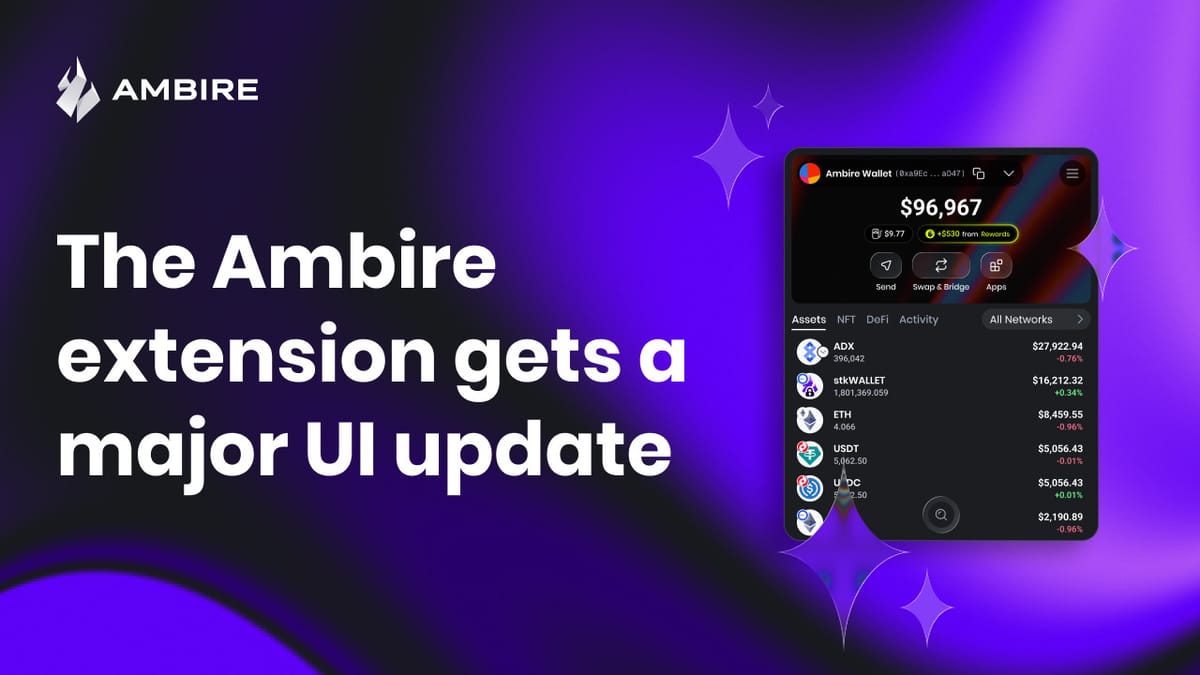
The redesign grew out of work on the Ambire mobile app, so the whole thing is being pushed toward a more consistent experience across desktop and mobile. That is also why the update feels more important than a simple visual refresh. It is laying down the base for the app as well.
Ambire also reworked the token details page, which makes sense. If you open a token inside your wallet, you want the useful stuff right there without digging through clutter. The new version seems built around that idea 📱
To devs’ credit, they did not throw away the Ambire look completely. The colorful style stays and the upcoming mobile app keeps the same identity. The difference is that the layout underneath is cleaner 🖼
The updated extension has been submitted for Chrome Web Store review and should roll out automatically once approved. Mobile testing is already underway internally, and the first beta testers are expected to get a look at EthCC 👀
For years UI/UX has been the Achilles’ heel of the industry. Good to see devs actively trying to solve this, piece by piece 🫡
The dream of "Metaverse" - it's over isn't it?
If you were around for the COVID era crypto run, you remember how the whole thing felt. Everyone stuck at home, charts going up, virtual communities and chat groups turning into full time jobs and somehow we collectively convinced ourselves that the next step for humanity was a 3D hangout universe with floating legs.
Back then “the Metaverse” worked because people had the time and the cabin fever. If you can’t go outside, the idea of buying digital land and “meeting up” with other trapped humans starts sounding like a plan 🤪
People were spending stupid money on metaverse plots like it was Malibu.
VR Horizon Worlds is getting shut down
Meta says it will end VR support for Horizon Worlds (its Metaverse project) in June and move to a mobile only experience.
From June 15, users won’t be able to build, publish, or update worlds and they also won’t be able to access Horizon Worlds on Meta Quest headsets 🥽
So yeah, the flagship “VR social world” gets downgraded into a phone app. Which is a way of saying the headset version never became what it was supposed to be 🤒
Meta had already been testing Horizon Worlds as a mobile platform, and that direction is now official. The company also pointed to the reality that the big multiplayer worlds people actually use are already on PC, console, and mobile.
Fortnite and Roblox are the real competition here, and neither of them needs you to buy a headset to use it 🤷♂

The money behind the decision is brutal
This isn’t happening in a vacuum. Reality Labs has been an expensive hobby for Meta, for years, and the numbers are hard to ignore 👇
Meta’s Reality Labs unit reportedly logged about $6B in losses in Q4 2025, and cumulative losses tied to the Metaverse effort are close to $80B since 2020. In January, Meta cut around 1,000 jobs from Reality Labs while closing some VR game and content studios.
When a division is chewing through that kind of cash, the product roadmap stops being “dream big” and turns into “what can we keep alive that people might actually open daily”. Mobile is the easy answer. Lower friction, bigger audience, less hardware dependency. But you can’t say a mobile app is the future of anything, sadly 😐
This feels familiar to those of us who watched typical crypto trends and quirks come and go.
During the COVID bull, crypto was printing narratives every week. NFTs became status. Metaverse land became flex culture. Everything was “the future” because the market was paying for optimism by the minute ⌚
Then the world reopened and suddenly the “digital neighborhood near Snoop Dogg” thing became a bored era artifact.
Meta isn’t admitting all that directly, but the decision tells you enough. VR first was the big bet. Mobile is the salvage plan.
And yeah, crypto metaverse tokens already got the memo a long time ago and this decision is definitely not going to resurrect them ☠
Crypto tries the grown up route: teach DeFi properly
If you have ever tried explaining DeFi to a regular person, you know how it goes. You start with “it’s finance but onchain” they nod politely, and 15 minutes later you are trying to justify why a cartoon doggy can move markets and how it all beats the Fiat that’s inside their banking app.
So the industry is trying a different approach: stop “pitching” → start teaching.
A group of 21 crypto orgs spearheaded by 1inch have signed an open letter urging top US colleges to teach decentralized finance as part of their curriculum 👇
The goal isn’t to “make everyone a Solidity dev” or anything, it’s rather practical: DeFi is already a live financial system people interact with, and the next wave of graduates who end up in finance, law, compliance, risk, product, and operations should not have to learn it by trial and error 🧠
Because a lot of DeFi roles are not engineering roles. They are “understand the system well enough to not make bad calls” roles.
If you work in risk, you need to understand liquidation mechanics, collateral types, oracle risk and how quickly leverage can go crazy 🪙
If you work in compliance or legal, you need to understand what the product is doing, what custody means in an onchain context and where responsibility sits when there is no traditional intermediary. If you work in product, you need to understand why “simple UX” often hides complex sequencing, and why users lose funds through the same patterns over and over 🤓
Universities are not starting from zero, but what exists now is scattered.
MIT has run blockchain and digital currency programs for years. Harvard offers a blockchain innovation course. Some others have offered a Bitcoin protocol course, at best 🤔
There are plenty of guest lectures and campus clubs too. The problem is that this material often lives in isolated pockets. A course here, a lab there, a professor who includes a module because they care.
A practical DeFi course has to cover how systems function and how they fail. That means AMMs, liquidity provision, slippage, governance, incentives, lending markets, liquidations, oracle design, MEV, smart contract risk and the operational reality that user losses often come from approvals, phishing and misunderstanding what a transaction is authorizing 🙃
This is also why it helps to teach DeFi in business and law contexts rather than only as computer science. DeFi is not only code. It is market structure, incentives, behavior under leverage, governance disputes and legal gray areas.
Treat it as a programming elective and you completely miss what the space is really about 🤠
SEC finally starts recognizing what crypto is
For years, crypto in the US has been stuck in that same exhausting gray zone where everyone knew the SEC could show up at any moment, but nobody could get a straight answer on what exactly counted as what.
A token could be treated like a security, a commodity, a collectible, a network tool or just an excuse for another enforcement action, and most of the market was left to figure it out by trial, error and legal bills 💰
That is why this matters so much 👀
The SEC has finally put out an interpretation that starts drawing real lines around crypto instead of keeping the whole industry inside one giant fog machine. And the important thing is not just that it said something new, but that it finally recognized that crypto assets are not all the same thing 🔒
Under this interpretation, digital commodities, digital collectibles, digital tools, and compliant payment stablecoins are treated outside securities law, while assets and arrangements that actually meet the test for securities stay under securities rules.
That sounds basic, almost embarrassingly basic, but this is the kind of recognition the market has been waiting on for years.
The regulator is finally admitting that Bitcoin is not the same as a collectible, an ENS domain, a payment stablecoin or a token wrapped inside an investment contract, which should have been obvious from the beginning but somehow had to be dragged into the light this late 🥱
The names being discussed in coverage around the interpretation make that even clearer.
Assets like Bitcoin, Litecoin, Cardano, Chainlink, Solana, XRP and others are being treated as digital commodities 📦
Collectibles like CryptoPunks and similar assets are being treated separately 🐸
Tools such as ENS domains are not being shoved into the same box either.
Compliant stablecoins are being recognized on their own terms too. That matters because it gives huge parts of the market a defined place to stand instead of forcing everything to live under the same legal threat. And yes that threat is real no matter if you live in the US or not.
It also clears up a lot of the nonsense around actual network activity. The interpretation says protocol mining, protocol staking and wrapping a non security crypto asset do not amount to the offer and sale of a security. Certain airdrops also do not count as an investment of money under Howey 🤓
That is the kind of thing that should have been clear ages ago, because crypto has spent years dealing with this absurd situation where ordinary onchain activity could be dragged into a securities argument simply because the rules were never laid out properly.
Another point: early stage projects that are still building toward decentralization are not in the same position as mature networks and pretending otherwise has been one of the dumbest features of US crypto policy 🤡
That is where the safe harbor idea comes in naturally.
Paul Atkins floated a framework that would give projects time to build, make disclosures, and move toward decentralization without being hit immediately with the full force of securities registration before they have even had a realistic chance to get there.
It accepts something regulators have resisted admitting for years: not everything that begins in an early and messy state should be treated as if it is permanently trapped there 😬
Some networks take time to reach the shape they are aiming for, and a framework that allows that process to happen without immediate enforcement pressure is a lot more grounded than the old model where projects were expected to be fully formed, fully decentralized and fully compliant from the first minute they appeared 😶
It definitely does not mean every token now gets a free pass. If something is genuinely being offered in a way that fits securities law, then securities law still applies.
But even there, the new approach seems to leave room for a more realistic view of how crypto assets evolve over time. An asset does not have to be frozen forever inside the most restrictive possible reading of its earliest stage, especially if the network, the structure and the surrounding facts change 🥸

After years of confusion, lawsuits, contradictions, and the usual dance where the industry was told to comply without ever being told clearly what compliance even looked like, the SEC is finally moving toward a framework that treats crypto like a real category made up of different things rather than one giant legal headache 🥲
Other worthy reads
“Stablecoins Are Coming for FX Markets” by Delphi Digital:
“The $18B niche market nobody in Web3 is talking about” by Cova:
“The Great Perpification” from MONK:
MEMES


That's all for now, frens.
We'll meet in a week! And remember, the market conditions are temporary, but our commitment to building a better Web3 is here to stay. Thanks for joining us, and we look forward to seeing you back next week. Cheers!
Yours, The 🔥 Team
Brought to you by Ambire: The Only Web3 Wallet That You’ll Need!
